North American Free Trade Agreement (NAFTA), Article 1904 Binational Panel Review: Notice of Request for Panel Review

AGENCY:

United States Section, NAFTA Secretariat, International Trade Administration, Department of Commerce.

ACTION:

Notice of NAFTA Requests for Panel Review in the matter of Certain Fabricated Structural Steel from Canada; Final Results of Antidumping Duty Administrative Review (Secretariat File Number: USA-CDA-2020-1904-02).

SUMMARY:

Requests for Panel Review were filed on behalf of Canatal Inc. (Industries Canatal) and Les Constructions Beauce-Atlas Inc. (“CBA”) with the United States Section of the NAFTA Secretariat on February 28, 2020, pursuant to NAFTA Article 1904. Panel Reviews were requested of the Department of Commerce's final antidumping duty determination regarding Certain Fabricated Structural Steel from Canada. The final determination was published in the Federal Register on January 30, 2020. The NAFTA Secretariat has assigned case number USA-CDA-2020-1904-02 to this request.

FOR FURTHER INFORMATION CONTACT:

Paul E. Morris, United States Secretary, NAFTA Secretariat, Room 2061, 1401 Constitution Avenue NW, Washington, DC 20230, 202-482-5438. Read More →

https://www.federalregister.gov/documents/2020/03/12/2020-05058/north-american-free-trade-agreement-nafta-article-1904-binational-panel-review-notice-of-request-for

Notice of Product Exclusions: China's Acts, Policies, and Practices Related to Technology Transfer, Intellectual Property, and Innovation

AGENCY:

Office of the United States Trade Representative.

ACTION:

Notice of product exclusions.

SUMMARY:

On August 20, 2019, at the direction of the President, the U.S. Trade Representative determined to modify the action being taken in the investigation by imposing additional duties of 10 percent ad valorem on goods of China with an annual trade value of approximately $300 billion as part of the action in the Section 301 investigation of China's acts, policies, and practices related to technology transfer, intellectual property, and innovation. The additional duties on products in List 1, which is set out in Annex A of that action, became effective on September 1, 2019. On August 30, 2019, at the direction of the President, the U.S. Trade Representative determined to increase the rate of the additional duty applicable to the tariff subheadings covered by the action announced in the August 20 notice from 10 percent to 15 percent. On January 22, 2020, the U.S. Trade Representative determined to reduce the rate from 15 percent to 7.5 percent. The U.S. Trade Representative initiated a product exclusion process in October 2019, and interested persons have submitted requests for the exclusion of specific products. This notice announces the U.S. Trade Representative's determination to grant certain exclusion requests, as specified in the Annex to this notice. The U.S. Trade Representative will continue to issue decisions on pending requests on a periodic basis.

DATES:

The product exclusions announced in this notice will apply as of September 1, 2019, the effective date of the $300 billion action, and will extend to September 1, 2020. Read More →

https://www.federalregister.gov/documents/2020/03/10/2020-05000/notice-of-product-exclusions-chinas-acts-policies-and-practices-related-to-technology-transfer

Establishment of the Interagency Committee on Trade in Automotive Goods Under Section 202A of the United States Mexico Canada Agreement Implementation Act

By the authority vested in me as President by the Constitution and the laws of the United States of America, including section 301 of title 3, United States Code, and section 202A of the United States-Mexico-Canada Agreement Implementation Act (Act) (Public Law 116-113), it is hereby ordered as follows:

Section 1Establishment of Interagency Committee. The Interagency Committee on Trade in Automotive Goods (Committee) is hereby established to provide advice, as appropriate, on the implementation, enforcement, and modification of provisions of the United States-Mexico-Canada Agreement (Agreement) that relate to automotive goods, including the automotive rules of origin and the alternative staging regime that are part of such rules. The Committee shall also review the operation of the Agreement with respect to trade in automotive goods, including the economic effects of the automotive rules of origin on the United States economy, workers, and consumers, and the impact of new technology on such rules.

Sec. 2Membership. The Committee shall be composed of the Secretary of Commerce, the Secretary of Labor, the United States Trade Representative (USTR), the Chairman of the United States International Trade Commission, and the Commissioner of U.S. Customs and Border Protection in the Department of Homeland Security. Members of the Committee may designate an officer of the United States within their respective executive department, agency, or component to serve as their representative on the Committee. The USTR shall serve as Chair of the Committee. The USTR may invite representatives from other executive departments or agencies, as the USTR determines are necessary, to participate as members or observers, and shall include the Secretary of the Treasury as a member of the Committee. Each executive department, agency, and component represented on the Committee shall ensure that the necessary staff are available to assist in performing the responsibilities of the Committee. Read More →

https://www.federalregister.gov/documents/2020/03/06/2020-04755/establishment-of-the-interagency-committee-on-trade-in-automotive-goods-under-section-202a-of-the

U.S. International Trade in Goods and Services, January 2020

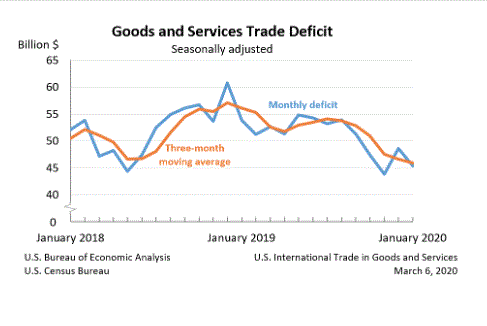
The U.S. Census Bureau and the U.S. Bureau of Economic Analysis announced today that the goods and services deficit was $45.3 billion in January, down $3.3 billion from $48.6 billion in December, revised.

View U.S. International Trade in GOODS AND SERVICES DEFICIT HERE:

Deficit: $45.3 Billion (-6.7%)*

Exports: $208.6 Billion (-0.4%)*

Imports: $253.9 Billion (-1.6%)(

Next Release: April 2, 2020

(*) Statistical significance is not applicable or not measurable.

Data adjusted for seasonaility but not price changes

Source: U.S. Census Bureau, U.S. Bureau of Economic Analysis; U.S. International Trade in Goods and Services, March 6, 2020

MTI-3-16-2020 SCREEN SHOT ARTICLE.GIF

Exports, Imports, and Balance (exhibit 1)

January exports were $208.6 billion, $0.9 billion less than December exports. January imports were $253.9 billion, $4.2 billion less than December imports.

The January decrease in the goods and services deficit reflected a decrease in the goods deficit of $2.6 billion to $67.0 billion and an increase in the services surplus of $0.6 billion to $21.7 billion.

Year-over-year, the goods and services deficit decreased $8.5 billion, or 15.8 percent, from January 2019. Exports increased $2.3 billion or 1.1 percent. Imports decreased $6.2 billion or 2.4 percent.

Three-Month Moving Averages (exhibit 2)

The average goods and services deficit decreased $0.7 billion to $45.9 billion for the three months ending in January.

  • Average exports increased $0.7 billion to $208.6 billion in January.

  • Average imports decreased less than $0.1 billion to $254.5 billion in January.

Year-over-year, the average goods and services deficit decreased $10.2 billion from the three months ending in January 2019.

  • Average exports increased $1.9 billion from January 2019.

  • Average imports decreased $8.2 billion from January 2019. Read More →

https://www.bea.gov/news/2020/us-international-trade-goods-and-services-january-2020

Coronavirus (COVID-19)

The Department of Homeland Security (DHS) efforts in preparedness and readiness have facilitated a speedy, whole-of-government response in confronting COVID-19, keeping Americans safe, and helping detect and slow the spread of the virus.

As part of Department-wide, layered response, U.S. Customs and Border Protection (CBP), the DHS Countering Weapons of Mass Destruction Office (CWMD), U.S. Coast Guard (USCG), Transportation Security Administration (TSA), Federal Emergency Management Agency (FEMA), U.S. Immigration and Customs Enforcement (ICE), the Cybersecurity and Infrastructure Security Agency (CISA) and others are actively working to protect the nation.

CBP and CWMD are providing direct support to the Centers for Disease Control and Prevention (CDC) efforts by conducting enhanced health screening at 11 major airports. At and between all air, land and sea Ports of Entry (POEs), CBP Officers (CBPOs) and Border Patrol Agents (BPAs) continue to identify and refer individuals with symptoms of COVID-19 or a travel history to China or Iran in the past 14 days to CDC or local public health officials for enhanced health screening. DHS CWMD houses the Department's Chief Medical Officer.

The routing of all flights with passengers who have recently been in China and Iran through select airports with established resources, procedures and personnel is an important, prudent step DHS is taking actively to decrease the strain on public health officials screening incoming travelers and protect the American public. Read More →

https://www.dhs.gov/coronavirus?utm_source=(direct)&utm_medium=(none)&utm_term=undefined&utm_content=undefined&utm_campaign=(not%20set)&gclid=undefined&dclid=undefined&GAID=1943773426.1584373792

USITC INSTITUTES SECTION 337 INVESTIGATION OF CERTAIN NICOTINE POUCHES AND COMPONENTS THEREOF AND METHODS OF MAKING THE SAME

March 9, 2020

News Release 20-020

Inv. No. 337-TA-1192

Contact: Peg O'Laughlin, 202-205-1819

The U.S. International Trade Commission (USITC) has voted to institute an investigation of certain nicotine pouches and components thereof and methods of making the same.  The products at issue in the investigation are described in the Commission’s notice of investigation.

The investigation is based on a complaint filed by NYZ AB of Stockholm, Sweden; Swedish Match North America, LLC, of Richmond, VA; Pinkerton Tobacco Co., LP, of Owensboro, KY; and wm17 holding GmbH of Baar, Switzerland, on February 10, 2020.  The complaint alleges violations of section 337 of the Tariff Act of 1930 in the importation into the United States and sale of certain nicotine pouches and components thereof and methods of making the same that infringe a patent asserted by the complainants.  The complainants request that the USITC issue a limited exclusion order and cease and desist orders.  The USITC has identified the following as respondents in this investigation:

The Art Factory AB of Helsingborg, Sweden;
Kretek International, Inc., of Moorpark, CA; and
DRYFT Sciences, LLC, of Moorpark, CA.

By instituting this investigation (337-TA-1192), the USITC has not yet made any decision on the merits of the case.  The USITC’s Chief Administrative Law Judge will assign the case to one of the USITC’s administrative law judges (ALJ), who will schedule and hold an evidentiary hearing.  The ALJ will make an initial determination as to whether there is a violation of section 337; that initial determination is subject to review by the Commission.

The USITC will make a final determination in the investigation at the earliest practicable time.  Within 45 days after institution of the investigation, the USITC will set a target date for completing the investigation.  USITC remedial orders in section 337 cases are effective when issued and become final 60 days after issuance unless disapproved for policy reasons by the U.S. Trade Representative within that 60-day period.

# # #

https://www.usitc.gov/press_room/news_release/2020/er0309ll1452.htm

Commerce Preliminarily Finds Dumping of Imports of Polyethylene Terephthalate Sheet from Korea and Oman

FACT SHEET

Commerce Preliminarily Finds Dumping of Imports of Polyethylene Terephthalate Sheet from Korea and Oman

• On February 26, 2020, the Department of Commerce (Commerce) announced its affirmative preliminary determinations in the antidumping duty (AD) investigations of imports of polyethylene terephthalate sheet (PET Sheet) from Korea and Oman.

• The AD law provides U.S. businesses and workers with a transparent, quasi-judicial, and internationally accepted mechanism to seek relief from the market distorting effects caused by injurious dumping of imports into the United States, establishing an opportunity to compete on a level playing field.

• For the purpose of AD investigations, dumping occurs when a foreign company sells an imported product in the United States at less than fair value.

• In the Korea investigation, Commerce calculated a preliminary dumping rate of 8.02 percent for mandatory respondent Jin Young Chemical Co., Ltd. Commerce assigned a preliminary dumping rate of 52.01 percent to mandatory respondent Plastech Co., Ltd., based on total adverse facts available. This rate will also apply to companies that failed to respond to Commerce’s requests for information. Commerce assigned a preliminary dumping margin of 8.02 percent to all other producers/exporters in Korea.

• In the Oman investigation, Commerce calculated a preliminary dumping margin of 2.78 percent for mandatory respondent OCTAL SAOC – FZC (OCTAL). Commerce assigned a preliminary dumping margin of 2.78 percent to all other producers/exporters in Oman. Commerce assigned a preliminary dumping margin of 2.78 percent to all other producers/exporters in Oman.

• As a result of the preliminary affirmative determinations, Commerce will instruct U.S. Customs and Border Protection (CBP) to require cash deposits for imports of PET sheet from Korea and Oman based on these preliminary rates.

• The petitioners are Advanced Extrusions, Inc. (Rogers, MN), Ex-Tech Plastics, Inc. (Richmond, IL), and Multi-Plastics Extrusions, Inc. (Hazleton, PA).

• The scope of these investigations is listed in Appendix I.

• In 2018, imports of PET sheet from Korea and Oman were valued at an estimated $90.0 million and $208.3 million, respectively. More →

https://enforcement.trade.gov/download/factsheets/factsheet-multiple-pet-sheet-ad-prelim-022620.pdf

Notice of the 2020 Generalized System of Preferences (GSP) Annual Review and the Deadline for Filing Petitions

AGENCY:

Office of the United States Trade Representative.

ACTION:

Notice of available statistics and announcement of the 2020 GSP Annual Review.

SUMMARY:

The Office of the United States Trade Representative (USTR) will consider petitions to modify the GSP status of GSP beneficiary developing countries (BDCs) because of country practices; add products to GSP eligibility; remove products from GSP eligibility for one or more countries; waive competitive need limitations (CNLs); deny de minimis waivers for eligible products; or redesignate currently excluded products. This review will include separate hearings on accepted country practice review and product petitions, which USTR will announce in the Federal Register at a later date.

DATES:

March 26, 2020 at 11:59 p.m. EST: Deadline for submission of petitions to modify the GSP status of GSP BDCs because of country practices; add products to GSP eligibility; remove products from GSP eligibility for one or more countries; waive CNLs; deny de minimis waivers for eligible products; or redesignate currently excluded products. USTR will not consider petitions submitted after the deadline. USTR will announce the petitions accepted for review, along with a schedule for any related public hearings, and the opportunity for the public to provide comments at a later date. More →

https://www.federalregister.gov/documents/2020/03/02/2020-04220/notice-of-the-2020-generalized-system-of-preferences-gsp-annual-review-and-the-deadline-for-filing

USITC VOTES TO CONTINUE INVESTIGATIONS CONCERNING VERTICAL SHAFT ENGINES FROM CHINA

February 28, 2020

News Release 20-016

Inv. No. 701-TA-637 and 731-TA-1471 (Preliminary)

Contact: Peg O'Laughlin, 202-205-1819

The United States International Trade Commission (USITC) today determined that there is a reasonable indication that a U.S. industry is materially injured by reason of imports of vertical shaft engines from China that are allegedly subsidized and sold in the United States at less than fair value. 

Chairman David S. Johanson and Commissioners Rhonda K. Schmidtlein, Jason E. Kearns, Randolph J. Stayin, and Amy A. Karpel voted in the affirmative.

As a result of the Commission’s affirmative determinations, the U.S. Department of Commerce will continue with its antidumping and countervailing duty investigations concerning imports of these products from China, with its preliminary countervailing duty determination due on or about April 9, 2020, and its preliminary antidumping duty determination due on or about June 23, 2020.

The Commission’s public report Vertical Shaft Engines from China (Inv. Nos. 701-TA-637 and 731-TA-1471 (Preliminary), USITC Publication 5034, March 2020) will contain the views of the Commission and information developed during the investigations.

The report will be available after March 30, 2020; when available, it may be accessed on the USITC website at:  https://www.usitc.gov/commission_publications_library. More →

https://www.usitc.gov/press_room/news_release/2020/er0228ll1403.htm

APHIS Publishes Final Rule Establishing Exception to Lacey Act Declaration Requirement for Imported Products that Contain a Minimal Amount of Plant Material

The U.S. Department of Agriculture’s Animal and Plant Health Inspection Service (APHIS) is establishing an exception to the Lacey Act import declaration requirements for products containing a minimal, or “de minimis,” amount of plant material. The Lacey Act—which combats trafficking in illegally taken wildlife, fish, or plants—requires importers to prepare an import declaration for certain plants and plant products. The import declaration must include the scientific name of the plant, value of the importation, quantity of the plant, and name of the country where the plant was harvested. However, the Lacey Act does not address whether declaration requirements are necessary for otherwise non-plant products that contain a minimal amount of plant material, such as wooden buttons on a shirt.   

To address this, APHIS published a proposed rule on July 9, 2018 inviting public comments on two options for a de minimis exception to the declaration requirement for products that contain less than a certain amount of plant material. The first option would adopt an exception for products containing plant material that constitutes no more than 5 percent of the total weight of the individual product unit, provided that the total weight of plant material does not exceed 2.9 kilograms (6.93 pounds). The second option would adopt an exception for products containing plant material that constitutes no more than 5 percent of the total weight of the individual product, provided that the total weight does not exceed a designated amount of plant material by weight or board feet.   

After reviewing all comments received, APHIS decided to adopt an option based on weight: a threshold of no more than 5 percent of the total weight of the individual product unit, provided that the total weight of the plant material in an entry of products in the same 10-digit provision of the U.S. Harmonized Tariff Schedule does not exceed 2.9 kilograms. This exception ensures that the declaration requirement fulfills the intent of the Lacey Act while reducing the regulatory burden on importers. The exception will not apply to protected plant species. More →

https://www.aphis.usda.gov/aphis/newsroom/stakeholder-info/sa_by_date/sa-2020/sa-03/lacey-act-exception

USITC VOTES TO CONTINUE INVESTIGATIONS CONCERNING WOOD MOULDINGS AND MILLWORK PRODUCTS FROM BRAZIL AND CHINA

February 21, 2020

News Release 20-014

Inv. No. 701-TA-636 and 731-TA-11469-1470 (Preliminary)

Contact: Peg O'Laughlin, 202-205-1819

The United States International Trade Commission (USITC) today determined that there is a reasonable indication that a U.S. industry is materially injured by reason of imports of wood mouldings and millwork products from Brazil and China that are allegedly sold in the United States at less than fair value and subsidized by the government of China. 

Chairman David S. Johanson and Commissioners Rhonda K. Schmidtlein, Jason E. Kearns, and Amy A. Karpel voted in the affirmative.  Commissioner Randolph J. Stayin did not participate in these investigations.

As a result of the Commission’s affirmative determinations, the U.S. Department of Commerce will continue with its antidumping and countervailing duty investigations concerning imports of these products from Brazil and China, with its preliminary countervailing duty determination due on or about April 2, 2020, and its preliminary antidumping duty determinations due on or about June 16, 2020.

The Commission’s public report Wood Mouldings and Millwork Products from Brazil and China (Inv. Nos. 701-TA-636 and 731-TA-1469-1470 (Preliminary), USITC Publication 5030, March 2020) will contain the views of the Commission and information developed during the investigations.

The report will be available after March 23, 2020; when available, it may be accessed on the USITC website at:  https://www.usitc.gov/commission_publications_library.


UNITED STATES INTERNATIONAL TRADE COMMISSION
Washington, DC 20436

FACTUAL HIGHLIGHTS

Wood Mouldings and Millwork Products from Brazil and China
Investigation Nos. 701-TA-636 and 731-TA-1469-1470 (Preliminary)

Product Description:  The merchandise subject to these investigations consists of wood mouldings and millwork products that are made of wood (regardless of wood species), bamboo, laminated veneer lumber (LVL), or of wood and composite materials (where the composite materials make up less than 50 percent of the total merchandise), and which are continuously shaped wood that undergoes additional manufacturing or finger‐jointed or edgeglued moulding or millwork blanks (whether or not resawn).

Status of Proceedings:

1.   Type of investigation:  Preliminary antidumping and countervailing duty investigations.
2.   Petitioners:  The Coalition of American Millwork Producers is comprised of Bright Wood Corporation, Madras, OR; Cascade Wood Products, Inc., White City, OR; Endura Products, Inc., Colfax, NC; Sierra Pacific Industries, Red Bluff, CA; Sunset Moulding, Live Oak, CA; Woodgrain Millwork Inc., Fruitland, ID; and Yuba River Moulding, Yuba City, CA.
3.   USITC Institution Date: January 8, 2020.
4.   USITC Hearing Date:  January 29, 2020.
5.   USITC Vote Date:  February 21, 2020.
6.   USITC Notification to Commerce Date: February 24, 2020. More →

https://www.usitc.gov/press_room/news_release/2020/er0221ll1361.htm

USTR Announces Formation of Bilateral Evaluation and Dispute Resolution Office Pursuant to U.S.-China Phase One Agreement

02/14/2020

Washington, DC –  The Office of the United States Trade Representative today announced the formation of a new Bilateral Evaluation and Dispute Resolution Office, as envisioned by Article 7.2.2 of the Phase One economic and trade agreement signed by the United States and China on January 15, 2020.  This office will monitor China’s implementation of its commitments under the Phase One agreement and will be responsible for working with China’s corresponding Bilateral Evaluation and Dispute Resolution Office to address disputes that arise over implementation matters. 

Ambassador Jeffrey Gerrish will serve as the “designated Deputy United States Trade Representative” heading the new Bilateral Evaluation and Dispute Resolution Office in accordance with Article 7.2.2(a) of the Phase One agreement.  Interested parties may raise their concerns about implementation matters under the Phase One agreement by calling 202-395-3900. 

Background Information:

Chapter 7 of the U.S.-China Phase One economic and trade agreement sets forth an arrangement to ensure the effective implementation of the agreement and to allow the parties to resolve disputes in a fair and expeditious manner. 

This arrangement requires regular bilateral meetings to discuss implementation matters, with the parties meeting on a monthly basis at the “designated official” level, on a quarterly basis at the Deputy United States Trade Representative-Vice Minister level, and on a semi-annual basis at the United States Trade Representative-Vice Premier level. 

Separately, the arrangement also establishes strong procedures for addressing disputes related to the agreement.  A party can formally initiate a dispute by submitting an “Appeal” to the other party’s Bilateral Evaluation and Dispute Resolution Office.  Consultations then take place in an attempt to resolve the dispute, first at the “designated official” level and then, if needed, at the Deputy United States Trade Representative-Vice Minister level and finally at the United States Trade Representative-Vice Premier level.  If the dispute is not resolved through these consultations, the complaining party is allowed to take proportionate responsive action that it deems appropriate after providing advance notice to the party complained against.  The entire dispute resolution process will take approximately 90 days.  In addition, it has been expressly agreed that the complaining party in a dispute is not required to include information that could identify any company at issue or confidential business information.

The Phase One agreement enters into effect today, February 14, 2020.  The text of that agreement can be found here.  

###

https://ustr.gov/about-us/policy-offices/press-office/press-releases/2020/february/ustr-announces-formation-bilateral-evaluation-and-dispute-resolution-office-pursuant-us-china-phase

USTR Revises $7.5 Billion Award Implementation Against EU in Airbus Case

02/14/2020

Washington, DC – Under President’s Trump leadership, the United States won the largest award in WTO history on October 2, 2019 when it was authorized to take countermeasures on $7.5 billion in goods after a victory in its unfair trade practices case against the European Union, France, Germany, Spain, and the United Kingdom.  Pursuant to U.S. statute, the United States Trade Representative is now issuing a Notice in the Federal Register making adjustments to its WTO-authorized retaliation action, which was implemented on October 18, 2019. The United States is increasing the additional duty rate imposed on aircraft imported from the EU to 15% from 10%, effective March 18, 2020, and making certain other minor modifications. 

To read the Notice, click here.

For additional background, click here.

###

https://ustr.gov/about-us/policy-offices/press-office/press-releases/2020/february/ustr-revises-75-billion-award-implementation-against-eu-airbus-case

Commerce Initiates Antidumping Duty Investigation of Imports of Difluoromethane (R-32) from China

FACT SHEET

• On February 13, 2020, the Department of Commerce (Commerce) announced the initiation of an antidumping duty (AD) investigation of imports of difluoromethane (R-32) from China.

• The AD law provides U.S. businesses and workers with a transparent, quasi-judicial, and internationally accepted mechanism to seek relief from the market-distorting effects caused by injurious dumping and unfair subsidization of imports into the United States, establishing an opportunity to compete on a level playing field.

• For the purpose of AD investigations, dumping occurs when a foreign company sells a product in the United States at less than its fair value.

• The petitioner is Arkema, Inc. (King of Prussia, PA).

• The scope of this investigation is provided in Appendix I.

• The petitioner estimated that 2018 imports of R-32 from China were valued at approximately $21.5 million.

• The Initiation Decision Checklist is on file electronically via Enforcement and Compliance’s Antidumping and Countervailing Duty Centralized Electronic Service System (ACCESS). ACCESS is available to registered users at https://access.trade.gov, and to all parties in the Central Records Unit, Room B8024 of the main Department of Commerce building. Please refer to case number A570-121. NEXT STEPS

• The U.S. International Trade Commission (ITC) is scheduled to make its preliminary injury determination on or before March 9, 2020. More →

https://enforcement.trade.gov/download/factsheets/factsheet-prc-difluoromethane-ad-initiation-021320.pdf

ACE Truck Manifest QR Code Specifications Guide

On February 29, 2020, U.S. Customs and Border Protection (CBP) will begin supporting an optional Quick Response (QR) Code in the Automated Commercial Environment (ACE) Truck Portal. To use the QR Code, users will need to print it on the Truck Manifest Cover Sheet.

While QR codes are optional, the benefits of using them include:

  1. Uniquely identify the electronically filed manifest information associated with a conveyance.

  2. Minimize actions required of a driver.

  3. Maximize match probability.

For more information on how to participate using the QR Code on the Truck Manifest Cover Sheet, please see the QR specifications listed below. For any questions, please contact Linda Olsen at linda.m.olsen@cbp.dhs.gov. QR Specifications: The set of information that is desirable to store in either radio-frequency identification (RFID) or QR includes:

  1. Data layout version number (3 characters)

  2. Shipper (or agent) defined Trip ID (25 characters)

  3. Estimated date of arrival. (8 characters (yyyymmdd))

  4. 4. Tractor license plate id 1 (12 characters, including ISO country code (2), administrative unit code (3), and plate number (7).

  5. 5. Tractor license plate id 2 (12 characters)

The case not covered is where there are more than two license plates.

The total data load is, therefore, 3+25+8+12+12 = 60 characters. With a single-character delimiter between the data elements, this would require 64 characters.

Our recommendations are as follow:

  1. Both RFID user memory and QR code issued should use the same data content and layout.

  2. Both should use alphanumeric character sets (possibly including a delimiter or fill….More →

https://www.cbp.gov/sites/default/files/assets/documents/2020-Feb/Truck%20Manifest%20QR%20Specifications%20Document%20%281%29.pdf

USTR Announces Reallocation of Unused Fiscal Year 2020 WTO Tariff-Rate Quota Volume for Raw Cane Sugar

Washington, D.C. – The Office of the U.S. Trade Representative today announced the reallocation of the unused country-specific quota allocations under the tariff-rate quotas (TRQs) on imported raw cane sugar for Fiscal Year (FY) 2020 (October 1, 2019 through September 30, 2020).

TRQs allow countries to export specified quantities of a product to the United States at a relatively low tariff, but subject all imports of the product above a pre-determined threshold to a higher tariff.

On June 27, 2019, the Department of Agriculture (USDA) announced the establishment of the in-quota quantity for raw cane sugar for FY 2020.  The in-quota quantity for the TRQ on raw cane sugar FY 2020 is 1,117,195 metric tons raw value (MTRV), which is the minimum amount to which the United States is committed under the World Trade Organization (WTO Agreement).  On July 15, 2019, USTR provided notice of country-by-country allocations of the FY 2020 in-quota quantity of the WTO TRQ for imported raw cane sugar.  Based on consultation with quota holders, USTR has determined to reallocate 78,071 MTRV of the original TRQ quantity from those countries that have stated they do not plan to fill their FY 2020 allocated raw cane sugar quantities.  USTR is allocating the 78,071 MTRV to the following countries in the amounts specified below:

Country FY 2020 Raw Sugar Unused Reallocation (MTRV)

Argentina 4006

Australia 7,733

Barbados 652

Belize 1,025

Bolivia 745

Brazil 13,509

Colombia 2,236

Costa Rica 1,397

Dominican Republic 16,397

Ecuador 1,025

El Salvador 2,422

Eswatini (Swaziland) 1,490

Fiji 838

Guatemala 4,472

Guyana 1,118

Honduras 932

India 745

Jamaica 1,025

Malawi 932

Mauritius 1,118

Mozambique 1,211

Nicaragua 1,956

Panama 2,702

Peru 3,820

South Africa 2,143

Thailand 1,304

Zimbabwe 1,118

These allocations are based on the countries’ historical shipments to the United States. The allocations of the raw cane sugar WTO TRQ to countries that are net importers of sugar are conditioned on receipt of the appropriate verifications of origin and certificates for quota eligibility must accompany imports from any country for which an allocation has been provided.

Conversion factor: 1 metric ton = 1.10231125 short tons.

###

https://ustr.gov/about-us/policy-offices/press-office/press-releases/2020/february/ustr-announces-reallocation-unused-fiscal-year-2020-wto-tariff-rate-quota-volume-raw-cane-sugar

Notice of Product Exclusions and Amendments: China's Acts, Policies, and Practices Related to Technology Transfer, Intellectual Property, and Innovation

AGENCY:

Office of the United States Trade Representative.

ACTION:

Notice of product exclusions and amendments.

SUMMARY:

Effective July 6, 2018, the U.S. Trade Representative imposed additional duties on goods of China with an annual trade value of approximately $34 billion as part of the action in the Section 301 investigation of China's acts, policies, and practices related to technology transfer, intellectual property, and innovation. The U.S. Trade Representative's determination included a decision to establish a product exclusion process. The U.S. Trade Representative initiated the exclusion process in July 2018, and stakeholders have submitted requests for the exclusion of specific products. In December 2018, and March, April, May, June, July, September, October, and December 2019, the U.S. Trade Representative granted exclusion requests. This notice announces the U.S. Trade Representative's determination to grant additional exclusions, as specified in the Annex to this notice, and makes amendments to certain notes in the Harmonized Tariff Schedule of the United States (HTSUS). The U.S. Trade Representative will continue to issue decisions as necessary. More →

https://www.federalregister.gov/documents/2020/02/11/2020-02684/notice-of-product-exclusions-and-amendments-chinas-acts-policies-and-practices-related-to-technology

Commerce Preliminarily Finds Dumping of Imports of Utility Scale Wind Towers from Canada, Indonesia, Korea, and Vietnam

FACT SHEET

• On February 5, 2020, the Department of Commerce (Commerce) announced its affirmative preliminary determinations in the antidumping duty (AD) investigation of imports of Utility Scale Wind Towers from Canada, Indonesia, the Republic of Korea (Korea), and the Socialist Republic of Vietnam (Vietnam).

• The AD law provides U.S. businesses and workers with a transparent, quasi-judicial, and internationally accepted mechanism to seek relief from the market distorting effects caused by injurious dumping of imports into the United States, establishing an opportunity to compete on a level playing field.

• For the purpose of AD investigations, dumping occurs when a foreign company sells an imported product in the United States at less than fair value. • In the Canada investigation, Commerce calculated a preliminary dumping rate of 5.04 percent for sole mandatory respondent Marmen Inc./Marmen Énergie Inc. Commerce assigned a preliminary dumping margin of 5.04 percent for all other producers/exporters in Canada.

• In the Indonesia investigation, Commerce calculated a preliminary dumping rate of 6.38 percent for sole mandatory respondent PT Kenertec Power System. Commerce assigned a preliminary dumping margin of 6.38 percent for all other producers/exporters in Indonesia.

• In the Korea investigation, Commerce calculated a preliminary dumping rate of 5.98 percent for mandatory respondent Dongkuk S&C Co., Ltd. Commerce assigned a preliminary dumping margin of 5.98 percent for all other producers/exporters in Korea.

• In the Vietnam investigation, Commerce assigned a preliminary dumping rate of 65.96 percent, based on total adverse facts available, to mandatory respondent CS Wind Vietnam Co., Ltd. There is already an existing AD order on utility scale wind towers from Vietnam; the petition was filed with respect to one company that was excluded from the existing order. As noted below, the scope language for the investigations specifically excludes utility scale wind towers already subject to the existing order.

• As a result of the preliminary affirmative determinations, Commerce will instruct U.S. Customs and Border Protection (CBP) to require cash deposits for Utility Scale Wind Towers from Canada, Indonesia, Korea, and Vietnam based on these preliminary rates. More →

https://enforcement.trade.gov/download/factsheets/factsheet-multiple-utility-scale-wind-towers-ad-prelim-020520.pdf

Fresh Tomatoes From Mexico: Notification of Implementation of Inspection Program

AGENCY:

Enforcement and Compliance, International Trade Administration, Department of Commerce

DATES:

Applicable February 4, 2020.

SUMMARY:

The Department of Commerce (Commerce) hereby notifies the public and members of the trade community of the implementation of the inspection program established by Section VII.C of the 2019 Agreement Suspending the Antidumping Duty Investigation on Fresh Tomatoes from Mexico (2019 Suspension Agreement). Implementation of the Section VII.C inspection program will begin 60 days from the date of publication of this notice. Beginning 60 days from the date of publication of this notice, certain fresh tomatoes from Mexico shall be subject to a United States Department of Agriculture (USDA) inspection for quality and condition defects.

FOR FURTHER INFORMATION CONTACT:

Sally C. Gannon or David Cordell at (202) 482-0162 or (202) 482-0408, respectively; Bilateral Agreements Unit, Office of Policy, Enforcement and Compliance, International Trade Administration, U.S. Department of Commerce, 1401 Constitution Avenue NW, Washington, DC 20230.

SUPPLEMENTARY INFORMATION:

Background

On September 19, 2019, Commerce and signatory producers/exporters accounting for substantially all imports of fresh tomatoes from Mexico signed the 2019 Suspension Agreement.[1] Section VII.C of the 2019 Suspension Agreement states: “Beginning approximately (and no less than) six months from the Effective Date of the Agreement, all loads of subject merchandise, as specified in paragraph 2 of this section, shall be subject to a USDA inspection for quality and condition defects near the border after entering the United States. Commerce will consult with USDA on the development and implementation of the inspection program. The trade community will have at least 60 days' Start Printed Page 6144 advance notice prior to implementation of the inspection program.” [2] More →

https://www.federalregister.gov/documents/2020/02/04/2020-02166/fresh-tomatoes-from-mexico-notification-of-implementation-of-inspection-program