
USITC TO INVESTIGATE INDUSTRY AND SUPPLY CHAIN CONDITIONS AFFECTING COVID-19 INDUSTRY SECTORS AND PRODUCTS

The U.S. International Trade Commission (USITC) is seeking input for a new investigation on COVID-19 related industry sectors and particular products. The investigation, COVID-19 Related Goods: The U.S. Industry, Market, Trade, and Supply Chain Challenges, was requested by the U.S. House of Representatives’ Committee on Ways and Means and the U.S. Senate Committee on Finance in a letter received on August 13, 2020.

As requested, the USITC, an independent nonpartisan factfinding federal agency, will provide the following:

  • a brief overview of key U.S. industry sectors producing COVID-related goods, including, but not limited to, medical devices; personal protective equipment; and medicines (pharmaceuticals). The overviews will include, to the extent practicable, information on U.S. production, employment, and trade.

  • case studies on key products within each relevant industry sector, including N95 respirators, ventilators, vaccines, and COVID-19 test kits. The case studies will focus on products for which there were reported shortages in the first half of 2020, including those affected by supply chain fragility, blockages, or barriers, and will include information on:

  • the U.S. industry, market, and trade, including, to the extent available:

    • the product, including key components and the production process;

    • the size and characteristics of the U.S. market;

    • the U.S. manufacturing industry, including key producers of finished goods and intermediate inputs, the extent of U.S. production, and employment; and

    • U.S. imports of finished goods and inputs, including leading source countries and supplying firms; and

  • supply chain challenges and constraints, including, but not limited to:

    • factors affecting domestic production, including, to the extent practicable, regulatory requirements that may impact entry into the market; and

    • foreign trade barriers and restrictions and other factors that may affect U.S. imports of finished goods or inputs needed for domestic production.

The USITC expects to deliver its report to the Committees by December 15, 2020.

The USITC is seeking input for the investigation from all interested parties and requests that the information focus on the issues for which the USITC is requested to provide information and advice. The USITC will hold a public hearing in connection with the investigation on September 23, 2020. See below for important information regarding the format and location of the hearing.

Requests to appear at the hearing should be filed no later than 5:15 p.m. on September 11, 2020, with the Secretary, U.S. International Trade Commission, 500 E Street SW, Washington, DC 20436. See below for important information regarding filing a request to appear at a USITC hearing. Read More→

https://www.usitc.gov/press_room/news_release/2020/er0821ll1634.htm
Notice of Product Exclusion Amendment: China's Acts, Policies, and Practices Related to Technology Transfer, Intellectual Property, and Innovation

AGENCY:

Office of the United States Trade Representative.

ACTION:

Notice.

SUMMARY:

Effective August 23, 2018, the U.S. Trade Representative imposed additional duties on goods of China with an annual trade value of approximately $16 billion as part of the action in the Section 301 investigation of China's acts, policies, and practices related to technology transfer, intellectual property, and innovation. The U.S. Trade Representative's determination included a decision to establish a product exclusion process. The U.S. Trade Representative initiated the exclusion process in September 2018, and stakeholders have submitted requests for the exclusion of specific products. In July, September, and October 2019, and February and July 2020, the U.S. Trade Representative granted exclusion requests. This notice announces the U.S. Trade Representative's determination to make an amendment to a previously granted exclusion.

DATES:

The amendment is retroactive to the date the original exclusion was published and does not extend the period for the original exclusion. U.S. Customs and Border Protection will issue instructions on entry guidance and implementation.

FOR FURTHER INFORMATION CONTACT:

For general questions about this notice, contact Associate General Counsel Philip Butler or Director of Industrial Goods Justin Hoffmann at (202) 395-5725. For specific questions on customs classification or implementation of the product exclusions identified in the Annex to this notice, contact traderemedy@cbp.dhs.gov. Read More→

https://www.federalregister.gov/documents/2020/08/13/2020-17654/notice-of-product-exclusion-amendment-chinas-acts-policies-and-practices-related-to-technology

U.S. DEPARTMENT OF COMMERCE PRELIMINARILY FINDS DUMPING OF VERTICAL SHAFT ENGINES FROM CHINA

WASHINGTON – Today, the U.S. Department of Commerce announced its affirmative preliminary determination in the antidumping duty (AD) investigation of imports of vertical shaft engines between 225cc and 999cc and parts thereof (vertical shaft engines) from China.

Commerce preliminarily determined that the dumping rates range from 219.07 to 543.18 percent.

As a result of today’s decision, Commerce will instruct U.S. Customs and Border Protection to collect cash deposits from importers of vertical shaft engines from China based on the preliminary rates noted above.  

In 2019, imports of vertical shaft engines from China were valued at an estimated $45.1 million. 

The petitioner is the Coalition of American Vertical Engine Producers, whose members are Kohler Co. (Kohler, Wisc.) and Briggs & Stratton Corporation (Wauwatosa, Wisc.).

Commerce is scheduled to announce its final determination in this investigation on or about January 4, 2021.

If Commerce’s final determination is affirmative, the U.S. International Trade Commission (ITC) will be scheduled to make its final injury determination on or about February 18, 2021. If Commerce makes an affirmative final determination of dumping and the ITC makes an affirmative final injury determination, Commerce will impose an AD order. If Commerce makes a negative final determination of dumping or the ITC makes a negative final determination of injury, the investigation will be terminated and no order will be imposed. 

Read the fact sheet on today’s decision.

The strict enforcement of U.S. trade law is a primary focus of the Trump administration. Since the beginning of the current Administration, Commerce has initiated 281 new AD and countervailing duty investigations – this is a 260 percent increase from the comparable period in the previous administration.

The antidumping duty law provides American businesses and workers with an internationally accepted mechanism to seek relief from the harmful effects of unfair pricing of imports into the United States. Commerce currently maintains 531 antidumping and countervailing duty orders which provide relief to American companies and industries impacted by unfair trade.

Foreign companies that price their products in the U.S. market below the cost of production or below prices in their home markets are subject to antidumping duties. 

Commerce’s Enforcement and Compliance unit within the International Trade Administration is responsible for vigorously enforcing U.S. trade laws and does so through an impartial, transparent process that abides by international rules and is based solely on factual evidence. Read More→

https://www.trade.gov/press-release/us-department-commerce-preliminarily-finds-dumping-vertical-shaft-engines-china

Softwood Lumber Research, Promotion, Consumer Education and Industry Information Order; Assessment Rate Increase

AGENCY:

Agricultural Marketing Service.

ACTION:

Proposed rule.

SUMMARY:

This proposal invites comments on amending the Softwood Lumber Research, Promotion, Consumer Education and Industry Information Order (Order) to increase the assessment rate from $0.35 to $0.41 per thousand board feet (mbf). The Order is administered by the Softwood Lumber Board (Board) with oversight by the U.S. Department of Agriculture (USDA). Under the program, assessments are collected from domestic manufacturers and importers and used for research and promotion projects designed to strengthen the position of softwood lumber in the marketplace. This proposal would also add the conversion factor for square meters to board feet and make one conforming change.

DATES:

Comments must be received by October 13, 2020.

ADDRESSES:

Interested persons are invited to submit written comments concerning this proposed rule. All comments must be submitted through the Federal e-rulemaking portal at http://www.regulations.gov and should reference the document number and the date and page number of this issue of the Federal Register. All comments submitted in response to this proposed rule will be included in the rulemaking record and will be made available to the public. Please be advised that the identity of the individuals or entities submitting comments will be made public on the internet at http://www.regulations.gov.

FOR FURTHER INFORMATION CONTACT:

Andrea Ricci, Marketing Specialist, Promotion and Economics Division, Specialty Crops Program, AMS, USDA, 1400 Independence Avenue SW, Room 1406-S, Stop 0244, Washington, DC 20250-0244; telephone: (202) 572-1442; facsimile: (202) 205-2800; or electronic mail: Andrea.Ricci@usda.gov.

SUPPLEMENTARY INFORMATION:

This proposal affecting 7 CFR part 1217 (herein the “Order”) is authorized under the Commodity Promotion, Research, and Information Act of 1996 (1996 Act) (7 U.S.C. 7411-7425). Read More→

https://www.federalregister.gov/documents/2020/08/13/2020-16554/softwood-lumber-research-promotion-consumer-education-and-industry-information-order-assessment-rate

USITC VOTES TO CONTINUE INVESTIGATIONS ON SILICON METAL FROM BOSNIA AND HERZEGOVINA, ICELAND, KAZAKHSTAN, AND MALAYSIA

The United States International Trade Commission (USITC) today determined that there is a reasonable indication that a U.S. industry is materially injured or threatened with material injury by reason of imports of silicon metal from Bosnia and Herzegovina, Iceland, and Malaysia that are allegedly sold in the United States at less than fair value and that are allegedly subsidized by the government of Kazakhstan.

Chair Jason E. Kearns, Vice Chair Randolph J. Stayin, and Commissioners David S. Johanson, Rhonda K. Schmidtlein, and Amy A. Karpel voted in the affirmative.

As a result of the Commission’s affirmative determinations, the U.S. Department of Commerce will continue its investigations of imports of silicon metal from Bosnia and Herzegovina, Iceland, Kazakhstan, and Malaysia, with its preliminary countervailing duty determination concerning imports of this product from Kazakhstan due on or about September 23, 2020, and its preliminary antidumping duty determinations concerning imports of this product from Bosnia and Herzegovina, Iceland, and Malaysia due on or about December 7, 2020.

The Commission’s public report Silicon Metal from Bosnia and Herzegovina, Iceland, Kazakhstan, and Malaysia (Inv. Nos. 701-TA-652 and 731-TA-1524-1526 (Preliminary), USITC Publication 5107, August 2020) will contain the views of the Commission and information developed during the investigations.

The report will be available after September 11, 2020; when available, it may be accessed on the USITC website at:  https://www.usitc.gov/commission_publications_library.


UNITED STATES INTERNATIONAL TRADE COMMISSION
Washington, DC 20436

FACTUAL HIGHLIGHTS

Silicon Metal from Bosnia-Herzegovina, Iceland, Kazakhstan, and Malaysia
Investigation Nos. 701-TA-652 and 731-TA-1524-1526 (Preliminary)

Product Description:  Silicon metal of all forms and sizes, including silicon powder, contains at least 85.00 percent but less than 99.99 percent silicon and less than 4.00 percent iron by actual weight. Specifically excluded is semiconductor grade silicon (containing at least 99.99 percent silicon by actual weight and classifiable under Harmonized Tariff Schedule of the United States (HTSUS) subheading 2804.61.00).

Status of Proceedings:

1.  Type of investigations:  Preliminary antidumping and countervailing duty investigations.
2.  Petitioners:  Globe Specialty Metals, Inc., Beverly, Ohio; and Mississippi Silicon LLC, Burnsville, Mississippi.
3.  USITC Institution Date:  Tuesday, June 30, 2020.
4.  USITC Conference Date:  Tuesday, July 21, 2020 (conducted through written statements, testimony, and questions and responses).
5.  USITC Vote Date:  Thursday, August 13, 2020.
6.  USITC Notification to Commerce Date:  Friday, August 14, 2020. Read More →

https://www.usitc.gov/press_room/news_release/2020/er0813ll1628.htm

Joint Statement of the United States and the European Union on a Tariff Agreement

United States Trade Representative Robert Lighthizer and European Union Trade Commissioner Phil Hogan today announced agreement on a package of tariff reductions that will increase market access for hundreds of millions of dollars in U.S. and EU exports.  These tariff reductions are the first U.S.-EU negotiated reductions in duties in more than two decades.

Under the agreement, the EU will eliminate tariffs on imports of U.S. live and frozen lobster products.  U.S. exports of these products to the EU were over $111 million in 2017.  The EU will eliminate these tariffs on a Most Favored Nation (MFN) basis, retroactive to begin August 1, 2020.  The EU tariffs will be eliminated for a period of five years and the European Commission will promptly initiate procedures aimed at making the tariff changes permanent.  The United States will reduce by 50% its tariff rates on certain products exported by the EU worth an average annual trade value of $160 million, including certain prepared meals, certain crystal glassware, surface preparations, propellant powders, cigarette lighters and lighter parts.  The U.S. tariff reductions will also be made on an MFN basis and retroactive to begin August 1, 2020.

“As part of improving EU-US relations, this mutually beneficial agreement will bring positive results to the economies of both the United States and the European Union.  We intend for this package of tariff reductions to mark just the beginning of a process that will lead to additional agreements that create more free, fair, and reciprocal transatlantic trade,” said Ambassador Lighthizer and Commissioner Hogan.  

Timeline on Negotiations:

In 2019, at the direction of President Donald J. Trump, the United States completed formal procedures necessary to launch negotiations on a trade agreement, as did the European Commission. 

In September 2018, as required by the Bipartisan Congressional Trade Priorities and Accountability Act of 2015, Ambassador Lighthizer consulted with members of Congress on the Trump Administration’s interest in launching trade negotiations with the EU.  On October 16, 2018, the Office of the United States Trade Representative officially notified Congress that President Trump intended to launch trade negotiations with the EU.  On January 11, 2019, following consultations with Congress and public comment period from U.S. stakeholders, the Trump Administration issued formal U.S. negotiating objectives for the EU.

The agreement being announced today arose out of continuing engagement with the EU on these issues.

###

https://ustr.gov/about-us/policy-offices/press-office/press-releases/2020/august/joint-statement-united-states-and-european-union-tariff-agreement

USITC VOTES TO CONTINUE INVESTIGATIONS ON STANDARD STEEL WELDED WIRE MESH FROM MEXICO

The United States International Trade Commission (USITC) today determined that there is a reasonable indication that a U.S. industry is materially injured by reason of imports of standard steel welded wire mesh from Mexico that are allegedly subsidized and sold in the United States at less than fair value.

Chair Jason E. Kearns, Vice Chair Randolph J. Stayin, and Commissioners David S. Johanson, Rhonda K. Schmidtlein, and Amy A. Karpel voted in the affirmative.

As a result of the Commission’s affirmative determinations, the U.S. Department of Commerce will continue its investigations of imports of standard steel welded wire mesh from Mexico, with its preliminary countervailing duty determination due on or about September 23, 2020, and its preliminary antidumping duty determination due on or about December 7, 2020.

The Commission’s public report Standard Steel Welded Wire Mesh from Mexico (Inv. Nos. 701-TA-653 and 731-TA-1527 (Preliminary), USITC Publication 5109, August 2020) will contain the views of the Commission and information developed during the investigations.

The report will be available after September 11, 2020; when available, it may be accessed on the USITC website at:  https://www.usitc.gov/commission_publications_library. Read More →

https://www.usitc.gov/press_room/news_release/2020/er0813ll1626.htm

USITC VOTES TO CONTINUE INVESTIGATION ON SEAMLESS REFINED COPPER PIPE AND TUBE FROM VIETNAM

The United States International Trade Commission (USITC) today determined that there is a reasonable indication that a U.S. industry is materially injured by reason of imports of seamless refined copper pipe and tube from Vietnam that are allegedly sold in the United States at less than fair value. 

Chair Jason E. Kearns, Vice Chair Randolph J. Stayin, and Commissioners David S. Johanson, Rhonda K. Schmidtlein, and Amy A. Karpel voted in the affirmative. 

As a result of the Commission’s affirmative determination, the U.S. Department of Commerce will continue its investigation of imports of seamless refined copper pipe and tube from Vietnam, with its preliminary antidumping duty determination due on or about December 7, 2020. 

The Commission’s public report Seamless Refined Copper Pipe and Tube from Vietnam (Inv. No. 731-TA-1528 (Preliminary), USITC Publication 5108, August 2020) will contain the views of the Commission and information developed during the investigation.

The report will be available after September 11, 2020; when available, it may be accessed on the USITC website at:  https://www.usitc.gov/commission_publications_library. Read More →

https://www.usitc.gov/press_room/news_release/2020/er0813ll1627.htm

USITC VOTES TO CONTINUE INVESTIGATIONS ON SILICON METAL FROM BOSNIA AND HERZEGOVINA, ICELAND, KAZAKHSTAN, AND MALAYSIA

The United States International Trade Commission (USITC) today determined that there is a reasonable indication that a U.S. industry is materially injured or threatened with material injury by reason of imports of silicon metal from Bosnia and Herzegovina, Iceland, and Malaysia that are allegedly sold in the United States at less than fair value and that are allegedly subsidized by the government of Kazakhstan.

Chair Jason E. Kearns, Vice Chair Randolph J. Stayin, and Commissioners David S. Johanson, Rhonda K. Schmidtlein, and Amy A. Karpel voted in the affirmative.

As a result of the Commission’s affirmative determinations, the U.S. Department of Commerce will continue its investigations of imports of silicon metal from Bosnia and Herzegovina, Iceland, Kazakhstan, and Malaysia, with its preliminary countervailing duty determination concerning imports of this product from Kazakhstan due on or about September 23, 2020, and its preliminary antidumping duty determinations concerning imports of this product from Bosnia and Herzegovina, Iceland, and Malaysia due on or about December 7, 2020.

The Commission’s public report Silicon Metal from Bosnia and Herzegovina, Iceland, Kazakhstan, and Malaysia (Inv. Nos. 701-TA-652 and 731-TA-1524-1526 (Preliminary), USITC Publication 5107, August 2020) will contain the views of the Commission and information developed during the investigations.

The report will be available after September 11, 2020; when available, it may be accessed on the USITC website at:  https://www.usitc.gov/commission_publications_library. Read More →

https://www.usitc.gov/press_room/news_release/2020/er0813ll1628.htm

U.S. International Trade in Goods and Services, June 2020

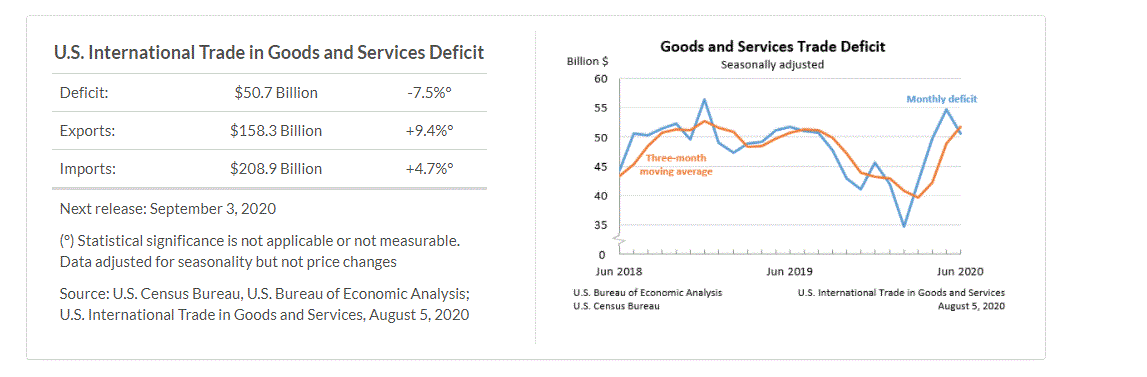
The U.S. Census Bureau and the U.S. Bureau of Economic Analysis announced today that the goods and services deficit was $50.7 billion in June, down $4.1 billion from $54.8 billion in May, revised.

US International Trade in Goods and Services Deficit.GIF


Coronavirus (COVID-19) Impact on May 2020 International Trade in Goods and Services

Exports and imports increased in June following monthly declines since March that were, in part, due to the impact of COVID-19, as many businesses were operating at limited capacity or ceased operations completely, and the movement of travelers across borders was restricted. The full economic effects of the COVID-19 pandemic cannot be quantified in the trade statistics for June because the impacts are generally embedded in source data and cannot be separately identified. The Census Bureau and the Bureau of Economic Analysis have monitored data quality and determined estimates in this release meet publication standards. For more information on the impact of COVID-19 on the statistics, see the frequently asked questions on goods from the Census Bureau and on services from BEA.

Exports, Imports, and Balance (exhibit 1)

June exports were $158.3 billion, $13.6 billion more than May exports. June imports were $208.9 billion, $9.5 billion more than May imports.

The June decrease in the goods and services deficit reflected a decrease in the goods deficit of $4.0 billion to $72.2 billion and an increase in the services surplus of $0.1 billion to $21.5 billion.

Year-to-date, the goods and services deficit decreased $23.1 billion, or 7.8 percent, from the same period in 2019. Exports decreased $199.1 billion or 15.7 percent. Imports decreased $222.3 billion or 14.2 percent.

Three-Month Moving Averages (exhibit 2)

The average goods and services deficit increased $2.8 billion to $51.8 billion for the three months ending in June.

  • Average exports decreased $10.6 billion to $151.4 billion in June.

  • Average imports decreased $7.9 billion to $203.1 billion in June.

Year-over-year, the average goods and services deficit increased $1.0 billion from the three months ending in June 2019.

  • Average exports decreased $59.1 billion from June 2019.

  • Average imports decreased $58.1 billion from June 2019. Read More →

https://www.bea.gov/news/2020/us-international-trade-goods-and-services-june-2020

Proclamation on Adjusting Imports of Aluminum Into the United States

1.  On January 19, 2018, the Secretary of Commerce (Secretary) transmitted to me a report on his investigation into the effect of imports of aluminum articles on the national security of the United States under section 232 of the Trade Expansion Act of 1962, as amended (19 U.S.C. 1862).  The Secretary found and advised me of his opinion that aluminum articles were being imported into the United States in such quantities and under such circumstances as to threaten to impair the national security of the United States.

2.  In Proclamation 9704 of March 8, 2018 (Adjusting Imports of Aluminum Into the United States), I concurred in the Secretary’s finding that aluminum articles were being imported into the United States in such quantities and under such circumstances as to threaten to impair the national security of the United States, and decided to adjust the imports of aluminum articles, as defined in clause 1 of Proclamation 9704, by imposing a 10 percent ad valorem tariff on such articles imported from most countries.  I further stated that any country with which we have a security relationship is welcome to discuss with the United States alternative ways to address the threatened impairment of the national security caused by imports from that country, and noted that, should the United States and any such country arrive at a satisfactory alternative means to address the threat to the national security such that I determine that imports from that country no longer threaten to impair the national security, I may remove or modify the restriction on aluminum articles imports from that country and, if necessary, adjust the tariff as it applies to other countries as the national security interests of the United States require.

3.  In Proclamation 9893 of May 19, 2019 (Adjusting Imports of Aluminum Into the United States), I noted that the United States had successfully concluded discussions with Canada on satisfactory alternative means to address the threatened impairment of the national security posed by aluminum imports from Canada.  In particular, the United States agreed on a range of measures with Canada that were expected to allow imports of aluminum from Canada to remain stable at historical levels without meaningful increases, thus permitting the domestic capacity utilization to remain reasonably commensurate with the target level recommended in the Secretary’s report.  These included measures to monitor for and avoid import surges.

4.  In light of this agreement, I determined that, under the framework in the agreement, imports of aluminum from Canada would no longer threaten to impair the national security, and thus I decided to exclude Canada from the tariff proclaimed in Proclamation 9704, as amended.  I noted that the United States would monitor the implementation and effectiveness of the measures agreed upon with Canada in addressing our national security needs, and that I may revisit this determination as appropriate.

5.  In Proclamation 9704, I also directed the Secretary to monitor imports of aluminum articles and inform me of any circumstances that in the Secretary’s opinion might indicate the need for further action under section 232 of the Trade Expansion Act of 1962, as amended, with respect to such imports. Read More →

https://www.whitehouse.gov/presidential-actions/proclamation-adjusting-imports-aluminum-united-states-080620/

Notice of Product Exclusion Extensions: China's Acts, Policies, and Practices Related to Technology Transfer, Intellectual Property, and Innovation

AGENCY:

Office of the United States Trade Representative.

ACTION:

Notice of product exclusion extensions.

SUMMARY:

Effective September 24, 2018, the U.S. Trade Representative imposed additional duties on goods of China with an annual trade value of approximately $200 billion as part of the action in the Section 301 investigation of China's acts, policies, and practices related to technology transfer, intellectual property, and innovation. The U.S. Trade Representative initiated the exclusion process on June 24, 2019, and has granted 15 sets of exclusions under the $200 billion action. These exclusions will expire on August 7, 2020. On May 6, 2020 and June 3, 2020, the U.S. Trade Representative established a processes for the public to comment on whether to extend particular exclusions granted under the $200 billion action for up to 12 months. This notice announces the U.S. Trade Representative's determination to extend certain exclusions through December 31, 2020.

DATES:

The product exclusion extensions announced in this notice will apply as of August 7, 2020, and extend through December 31, 2020. U.S. Customs and Border Protection will issue instructions on entry guidance and implementation.

FOR FURTHER INFORMATION CONTACT:

For general questions about this notice, contact Associate General Counsel Philip Butler or Assistant General Counsel Benjamin Allen, or Director of Industrial Goods Justin Hoffmann at (202) 395-5725. For specific questions on customs classification or implementation of the product exclusions identified in the Annex to this notice, contact traderemedy@cbp.dhs.gov. Read More →

https://www.federalregister.gov/documents/2020/08/11/2020-17509/notice-of-product-exclusion-extensions-chinas-acts-policies-and-practices-related-to-technology

U.S. DEPARTMENT OF COMMERCE INITIATES ANTIDUMPING DUTY AND COUNTERVAILING DUTY INVESTIGATIONS OF IMPORTS OF CERTAIN METAL LOCKERS AND PARTS THEREOF FROM CHINA

WASHINGTON – Today, the U.S. Department of Commerce announced the initiation of new antidumping (AD) and countervailing duty (CVD) investigations to determine whether certain metal lockers and parts thereof (metal lockers) from China are being dumped in the United States, and to determine if producers are receiving unfair subsidies.

The petitions were filed by List Industries, Inc. (Deerfield Beach, Fla.), Lyon LLC (Montgomery, Ill.), Penco Products, Inc. (Greenville, N.C.), and Tennsco LLC (Dickson, Tenn.).

In the AD investigation, Commerce will determine whether imports of metal lockers from China are being dumped in the U.S. market at less-than-fair value. The alleged dumping margins range from 245.96 to 322.25 percent.

In the CVD investigation, Commerce will determine whether Chinese producers of metal lockers are receiving unfair government subsidies. Commerce will investigate 24 subsidy programs, including renumeration programs, preferential lending programs, export programs, tax programs, and grant programs. 

If Commerce makes affirmative findings in these investigations, and if the U.S. International Trade Commission (ITC) determines that dumped and/or unfairly subsidized U.S. imports of metal lockers from China materially injure, or threaten material injury to, the U.S. industry, Commerce will impose duties on those imports in the amount of dumping and/or unfair subsidization found to exist.

The petitioners estimated that the value of imports of metal lockers from China in 2018 was $64 million. Read More →

https://www.trade.gov/press-release/us-department-commerce-initiates-antidumping-duty-and-countervailing-duty-10

U.S. DEPARTMENT OF COMMERCE INITIATES ANTIDUMPING AND COUNTERVAILING DUTY INVESTIGATIONS OF SEAMLESS CARBON AND ALLOY STEEL STANDARD, LINE, AND PRESSURE PIPE FROM...

THE CZECH REPUBLIC (AD), RUSSIA (AD/CVD), SOUTH KOREA (AD/CVD), AND UKRAINE (AD)

WASHINGTON – Today, the U.S. Department of Commerce announced the initiation of new antidumping (AD) investigations on imports of seamless carbon and alloy steel standard, line, and pressure pipe (seamless pipe) from the Czech Republic, Russia, South Korea (Korea), and Ukraine, and countervailing duty (CVD) investigations for these products from Russia and Korea.

The petitions were filed by Vallourec Star, LP (Houston, Texas). 

In the AD investigations, Commerce will determine whether imports of seamless pipe from the Czech Republic, Russia, Korea, and Ukraine are being dumped in the U.S. market at less-than-fair value. The alleged dumping margins range from 50.45 to 51.70 percent, 41.07 to 273.47 percent, 114.80 to 131.31 percent, and 42.38 to 42.88 percent for the Czech Republic, Russia, Korea, and Ukraine, respectively.

In the Russia and Korea CVD investigations, Commerce will determine whether Russian and Korean producers of subject merchandise are receiving unfair government subsidies. For Russia, Commerce will investigate 11 subsidy programs, including preferential lending, grant programs, and the provision of natural gas for less than adequate remuneration. For Korea, Commerce will investigate 38 subsidy programs, including preferential lending, tax programs, export insurance, grants, and electricity subsidies.

If Commerce makes affirmative findings in these investigations, and if the U.S. International Trade Commission (ITC) determines that dumped and/or unfairly subsidized U.S. imports of seamless pipe from the Czech Republic, Russia, Korea, and/or Ukraine materially injure, or threaten material injury to, the U.S. industry, Commerce will impose duties on those imports in the amount of dumping and/or unfair subsidization found to exist.

The 2019, imports of seamless pipe from the Czech Republic, Russia, Korea, and Ukraine were approximately valued at $37.1 million, $39.5 million, $24.4 million, and $40.6 million respectively. Read More →

https://www.trade.gov/press-release/us-department-commerce-initiates-antidumping-and-countervailing-duty-investigations

USITC DELIVERS FINAL REPORT ON MISCELLANEOUS TARIFF BILL PETITIONS TO CONGRESSIONAL COMMITTEES

The U.S. International Trade Commission (USITC or Commission) today submitted to Congressional committees its final report on miscellaneous tariff bill petitions it received under the 2016 American Manufacturing Competitiveness Act (AMCA).

The Commission submitted the report to the U.S. House of Representatives Committee on Ways and Means and the U.S. Senate Committee on Finance for their use in developing a miscellaneous tariff bill for Congressional consideration, as required by the AMCA.

The Commission’s final report and other background information can be found on the USITC website at https://www.usitc.gov/trade_tariffs/mtb_program_information.

In the report, the Commission categorizes petitions as either (a) petitions that meet the requirements of the Act with or without modification (Category I, II, III, or IV petitions), (b) petitions that do not contain the information required by the Act or for which the Commission determined that the petitioner was not a likely beneficiary (Category V petitions), or (c) petitions that the Commission does not recommend for inclusion in a miscellaneous tariff bill (Category VI petitions).

The Commission’s final report provides recommendations on 3,442 petitions.  The largest product categories were chemicals, accounting for 1,839 petitions; machinery and equipment, accounting for 715 petitions; and textiles, apparel and footwear, accounting for 581 petitions.  Of the 3,442 petitions, the Commission assigned 2,695 to Categories I through IV, 42 to Category V, and 705 to Category VI.

Background:  The USITC has now completed the second of two miscellaneous tariff bill petition cycles mandated by the AMCA.  Under the process, petitioners who could demonstrate that they are likely beneficiaries of a suspension or reduction of duties submitted petitions to the USITC between October 11, 2019, and December 10, 2019.  The USITC accepted public comments on the petitions between January 10, 2020, and February 24, 2020.  The USITC then evaluated the petitions to determine whether they met certain statutory requirements and submitted a preliminary report on the petitions received to the Committees, on June 9, 2020.  The USITC subsequently accepted additional, limited public comments on Category VI petitions from June 12, 2020, through June 22, 2020.  The submission of today’s report marks the completion of the second and final petition cycle required by the law.

# # #

https://www.usitc.gov/press_room/news_release/2020/er0810ll1622.htm

USITC INSTITUTES SECTION 337 INVESTIGATION OF CERTAIN ELECTRONIC DEVICES, INCLUDING COMPUTERS, TABLET COMPUTERS, AND COMPONENTS AND MODULES THEREOF

The U.S. International Trade Commission (USITC) has voted to institute an investigation of certain electronic devices, including computers, tablet computers, and components and modules thereof.  The products at issue in the investigation are described in the Commission’s notice of investigation.

The investigation is based on a complaint filed by Nokia Technologies Oy and Nokia Corporation, both of Espoo, Finland, on July 2, 2020.  The complaint was supplemented on July 17, 20, and 22, 2020.  The complaint alleges violations of section 337 of the Tariff Act of 1930 in the importation into the United States and sale of certain electronic devices, including computers, tablet computers, and components and modules thereof that infringe patents asserted by the complainants.  The complainants request that the USITC issue a limited exclusion order and cease and desist orders. 

The USITC has identified the following as respondents in this investigation:

Lenovo (United States), Inc., of Morrisville, NC;
Lenovo Group Limited of Quarry Bay, Hong Kong;
Lenovo (Beijing) Limited of Beijing, China;
Lenovo (Shanghai) Electronics Technology Co. Ltd. of Shanghai, China;
Lenovo PC HK Limited of Quarry Bay, Hong Kong;
Lenovo Information Products Shenzhen Co. Ltd. of Shenzhen, China;
Lenovo Mobile Communication of Wuhan, China;
Lenovo Corporation of Wujiang, China; and
Lenovo Centro Tecnologico S. de RL CV of Nuevo Leon, Mexico.

By instituting this investigation (337-TA-1208), the USITC has not yet made any decision on the merits of the case.  The USITC’s Chief Administrative Law Judge will assign the case to one of the USITC’s administrative law judges (ALJ), who will schedule and hold an evidentiary hearing.  The ALJ will make an initial determination as to whether there is a violation of section 337; that initial determination is subject to review by the Commission.

The USITC will make a final determination in the investigation at the earliest practicable time.  Within 45 days after institution of the investigation, the USITC will set a target date for completing the investigation.  USITC remedial orders in section 337 cases are effective when issued and become final 60 days after issuance unless disapproved for policy reasons by the U.S. Trade Representative within that 60-day period.

# # #

https://www.usitc.gov/press_room/news_release/2020/er0804ll1617.htm

USITC INSTITUTES SECTION 337 INVESTIGATION OF CERTAIN MOVABLE BARRIER OPERATOR SYSTEMS AND COMPONENTS THEREOF

The U.S. International Trade Commission (USITC) has voted to institute an investigation of certain movable barrier operator systems and components thereof.  The products at issue in the investigation are described in the Commission’s notice of investigation.

The investigation is based on a complaint filed by Overhead Door Corporation of Lewisville, TX, and GMI Holdings Inc. of Mount Hope, OH, on July 6, 2020.  The complaint alleges violations of section 337 of the Tariff Act of 1930 in the importation into the United States and sale of certain movable barrier operator systems and components thereof that infringe patents asserted by the complainants.  The complainants request that the USITC issue a limited exclusion order and a cease and desist order. 

The USITC has identified The Chamberlain Group, Inc., of Oak Brook, IL, as the respondent in this investigation.

By instituting this investigation (337-TA-1209), the USITC has not yet made any decision on the merits of the case.  The USITC’s Chief Administrative Law Judge will assign the case to one of the USITC’s administrative law judges (ALJ), who will schedule and hold an evidentiary hearing.  The ALJ will make an initial determination as to whether there is a violation of section 337; that initial determination is subject to review by the Commission.

The USITC will make a final determination in the investigation at the earliest practicable time.  Within 45 days after institution of the investigation, the USITC will set a target date for completing the investigation.  USITC remedial orders in section 337 cases are effective when issued and become final 60 days after issuance unless disapproved for policy reasons by the U.S. Trade Representative within that 60-day period.

# # #

https://www.usitc.gov/press_room/news_release/2020/er0804ll1618.htm

Notice of Product Exclusion Extensions: China's Acts, Policies, and Practices Related to Technology Transfer, Intellectual Property, and Innovation

AGENCY:

Office of the United States Trade Representative.

ACTION:

Notice of product exclusion extensions.

SUMMARY:

Effective August 23, 2018, the U.S. Trade Representative imposed additional duties on goods of China with an annual trade value of approximately $16 billion as part of the action in the Section 301 investigation of China's acts, policies, and practices related to technology transfer, intellectual property, and innovation. The U.S. Trade Representative initiated the exclusion process in September 2018 and, to date, has granted three sets of exclusions under the $16 billion action. The first set of exclusions was published in July 2019 and will expire in July 2020. On April 30, 2020, the U.S. Trade Representative established a process for the public to comment on whether to extend particular exclusions granted in July 2019 for up to 12 months. This notice announces the U.S. Trade Representative's determination to extend certain exclusions through December 31, 2020.

DATES:

The product exclusion extensions announced in this notice will apply as of July 31, 2020, and extend through December 31, 2020. U.S. Customs and Border Protection will issue instructions on entry guidance and implementation.

FOR FURTHER INFORMATION CONTACT:

For general questions about this notice, contact Assistant General Counsels Philip Butler or Benjamin Allen, or Director of Industrial Goods Justin Hoffmann at (202) 395-5725. For specific questions on customs classification or implementation of the product exclusions identified in the Annex to this notice, contact traderemedy@cbp.dhs.gov. Read More →

https://www.federalregister.gov/documents/2020/07/30/2020-16529/notice-of-product-exclusion-extensions-chinas-acts-policies-and-practices-related-to-technology

U.S. DEPARTMENT OF COMMERCE INITIATES ANTIDUMPING AND COUNTERVAILING DUTY INVESTIGATIONS OF SEAMLESS CARBON AND ALLOY STEEL STANDARD, LINE, AND PRESSURE PIPE FROM THE CZECH REPUBLIC (AD),

RUSSIA (AD/CVD), SOUTH KOREA (AD/CVD), AND UKRAINE (AD)

For Immediate Release
July 29, 2020
Contact: ITA Office of Public Affairs 
Phone: 202-482-3809

WASHINGTON – Today, the U.S. Department of Commerce announced the initiation of new antidumping (AD) investigations on imports of seamless carbon and alloy steel standard, line, and pressure pipe (seamless pipe) from the Czech Republic, Russia, South Korea (Korea), and Ukraine, and countervailing duty (CVD) investigations for these products from Russia and Korea.

The petitions were filed by Vallourec Star, LP (Houston, Texas). 

In the AD investigations, Commerce will determine whether imports of seamless pipe from the Czech Republic, Russia, Korea, and Ukraine are being dumped in the U.S. market at less-than-fair value. The alleged dumping margins range from 50.45 to 51.70 percent, 41.07 to 273.47 percent, 114.80 to 131.31 percent, and 42.38 to 42.88 percent for the Czech Republic, Russia, Korea, and Ukraine, respectively.

In the Russia and Korea CVD investigations, Commerce will determine whether Russian and Korean producers of subject merchandise are receiving unfair government subsidies. For Russia, Commerce will investigate 11 subsidy programs, including preferential lending, grant programs, and the provision of natural gas for less than adequate remuneration. For Korea, Commerce will investigate 38 subsidy programs, including preferential lending, tax programs, export insurance, grants, and electricity subsidies.

If Commerce makes affirmative findings in these investigations, and if the U.S. International Trade Commission (ITC) determines that dumped and/or unfairly subsidized U.S. imports of seamless pipe from the Czech Republic, Russia, Korea, and/or Ukraine materially injure, or threaten material injury to, the U.S. industry, Commerce will impose duties on those imports in the amount of dumping and/or unfair subsidization found to exist.

The 2019, imports of seamless pipe from the Czech Republic, Russia, Korea, and Ukraine were approximately valued at $37.1 million, $39.5 million, $24.4 million, and $40.6 million respectively. Read More →

https://www.trade.gov/press-release/us-department-commerce-initiates-antidumping-and-countervailing-duty-investigations

USITC INSTITUTES SECTION 337 INVESTIGATION OF CERTAIN PRE-FILLED SYRINGES FOR INTRAVITREAL INJECTION AND COMPONENTS THEREOF

The U.S. International Trade Commission (USITC) has voted to institute an investigation of certain pre-filled syringes for intravitreal injection and components thereof.  The products at issue in the investigation are described in the Commission’s notice of investigation.

The investigation is based on a complaint filed by Novartis Pharma AG of Basel, Switzerland, and Novartis Pharmaceuticals Corporation and Novartis Technology LLC, both of East Hanover, NJ, on June 19, 2020.  The complaint alleges violations of section 337 of the Tariff Act of 1930 in the importation into the United States and sale of certain pre-filled syringes for intravitreal injection and components thereof that infringe a patent asserted by the complainants.  The complainants request that the USITC issue a limited exclusion order and cease and a desist order. 

The USITC has identified Regeneron Pharmaceuticals, Inc., as the respondent in this investigation.

By instituting this investigation (337-TA-1207), the USITC has not yet made any decision on the merits of the case.  The USITC’s Chief Administrative Law Judge will assign the case to one of the USITC’s administrative law judges (ALJ), who will schedule and hold an evidentiary hearing.  The ALJ will make an initial determination as to whether there is a violation of section 337; that initial determination is subject to review by the Commission.

The USITC will make a final determination in the investigation at the earliest practicable time.  Within 45 days after institution of the investigation, the USITC will set a target date for completing the investigation.  USITC remedial orders in section 337 cases are effective when issued and become final 60 days after issuance unless disapproved for policy reasons by the U.S. Trade Representative within that 60-day period.

# # #

https://www.usitc.gov/press_room/news_release/2020/er0721ll1609.htm