
Media Gallery (click link below to view)
USITC RELEASES SHIFTS IN U.S. MERCHANDISE TRADE 2019
Shifts in U.S. Merchandise Trade 2019 (2019 Trade Shifts) is now available on the U.S. International Trade Commission (USITC) internet site.
The USITC, an independent, nonpartisan factfinding federal agency, produces its web-based comprehensive review of changes in U.S. trade patterns annually.
2019 Trade Shifts includes new interactive features, such as tables and graphics that allow users to view and refine, as they choose, the official government data presented. The report highlights changes in U.S. exports and imports by sector and select trading partners in terms of absolute value changes, relative percent changes, and changes in rank.
Highlights from the 2019 Trade Shifts report include:
In 2019, U.S. total exports and general imports both decreased though both were still above 2017 levels. Since U.S. imports fell more than U.S. exports, the overall merchandise trade deficit narrowed slightly.
U.S. total exports in two-thirds of merchandise sectors decreased from 2018 to 2019. The largest decreases in U.S. total exports were seen in the minerals and metals sector. The largest decrease in U.S. general imports by both absolute and percent change occurred in energy-related products.
Mexico, Canada, and China continued to be the main U.S. trading partners in 2019, consistent with past reports. China continued to be the top source of U.S. imports and remained the third largest destination market for U.S. exports. The largest destination markets for U.S. exports, however, were Canada and Mexico. Combined, U.S. exports to these two countries accounted for one-third of all U.S. exports of merchandise in 2019.
Shifts in U.S. Merchandise Trade 2019 can be accessed at https://www.usitc.gov/research_and_analysis/trade_shifts_2019/index.htm.
# # #
https://www.usitc.gov/press_room/news_release/2020/er0908ll1645.htm
President Trump Continues to Protect America’s Steel-Dependent National Security
Washington, DC – Since the beginning of his Administration, President Donald J. Trump has fought to protect American workers and the American steel industry. Today, the United States announces additional measures to address steel imports with two key trading partners – Mexico and Brazil. Under President Trump’s leadership, the United States continues to engage cooperatively with trading partners while acting responsibly to protect industries vital to our national security.
USTR Statements on Successful Conclusion of Steel Negotiations
Mexico and the United States have successfully concluded consultations held pursuant to the mechanism established in their Joint Statement of May 17, 2019 to address recent surges in imports from Mexico of three steel products: standard pipe, mechanical tubing, and semi-finished products. Mexico will establish a strict export monitoring regime for these products through June 1, 2021 and closely monitor shipments during this period. The United States will maintain the Section 232 duty exemption for imports of these products and will consult with Mexico in December of 2020 to discuss the state of trade in the relevant products in light of market conditions at that time.
The United States Trade Representative, Ambassador Robert Lighthizer, praised the Mexican government and his counterpart, Secretary of Economy Graciela Márquez Colín, for their cooperation and constructive engagement: “While the COVID-19 pandemic has challenged both of our countries in unprecedented ways, it has also underscored the importance of the strong economic partnership between the United States and Mexico and the need for close coordination to address common challenges. Our successful consultations on steel prove it is possible for us to work together to find creative solutions that serve the interests of workers and businesses in both countries. I thank my friend Secretary Márquez and her staff for their engagement and hard work over the last few weeks as we worked through this issue.”
***
Brazil and the United States have held successful talks regarding the steel trade between the two countries. In May of 2018, President Trump granted an exemption for Brazilian steel products from tariffs he imposed under Section 232, which allowed for duty-free importation of set quotas of various Brazilian steel products. The exemption was maintained in 2019 as the result of a constructive dialogue between Presidents Bolsonaro and Trump. In light of recent deterioration in market conditions brought on by the COVID-19 pandemic affecting domestic steel producers, the United States has deemed it necessary to reduce the remaining quota for Brazilian semi-finished steel products for the remainder of 2020 to 60,000 metric tons, down from 350,000, but will maintain existing quotas for other steel products. The United States will hold consultations with Brazil about the semi-finished steel quota for 2021 in December, by which time we hope market conditions will have improved.
The United States Trade Representative, Ambassador Robert Lighthizer, thanked the Brazilian government for the constructive dialogue in this matter: “Despite the challenges both of our countries face from COVID-19, discussions between the United States and Brazil on strengthening our trade relationship for the future are proceeding nicely. I thank Minister Ernesto Araújo for his willingness to discuss the state of the steel trade between our countries over the past few weeks. Our successful talks on this matter prove the value of candid, good faith engagement between trade partners.”
###
USITC INSTITUTES SECTION 337 INVESTIGATION OF CERTAIN VACUUM INSULATED FLASKS AND COMPONENTS THEREOF
The U.S. International Trade Commission (USITC) has voted to institute an investigation of certain vacuum insulated flasks and components thereof. The products at issue in the investigation are described in the Commission’s notice of investigation.
The investigation is based on a complaint filed by Steel Technology LLC d/b/a Hydro Flask of Bend, OR, and Helen of Troy Limited of El Paso, TX, on July 29, 2020. A supplement to the complaint was filed on August 18, 2020. The complaint, as supplemented, alleges violations of section 337 of the Tariff Act of 1930 in the importation into the United States and sale of certain vacuum insulated flasks and components thereof that infringe patents and registered trademarks asserted by the complainants. The complainants request that the USITC issue a general exclusion order, or in the alternative a limited exclusion order, and cease and desist orders.
The USITC has identified the following as respondents in this investigation:
Everich and Tomic Houseware Co., Ltd., of Hangzhou, China;
Cangnan Kaiyisi E-Commerce Technology Co., Ltd., of Wenzhou, Zhejiang, China;
Shenzhen Huichengyuan Technology Co., Ltd., of Shenzhen, Guangdong, China;
Sinbada Impex Co., Ltd., of Hefei, Anhui, China;
Yongkang Huiyun Commodity Co., Ltd., of Jinhua, Zhejiang, China;
Wuyi Loncin Bottle Co., Limited, of Jinhua, Zhejiang, China;
Yiwu Honglu Daily Necessities Co., Ltd., Yiwu City, Zhejiang, China;
Zhejiang Yuchuan Industry & Trade Co., Ltd., Jinhua, Zhejiang, China;
Zhejiang Yongkang Unique Industry & Trade Co., Ltd., Jinhua, Zhejiang, China;
Suzhou Prime Gifts Co., Ltd., of Suzhou, Jiangsu, China;
Hangzhou Yuehua Technology Co., Ltd., of Hangzhou, Zhejiang, China;
Guangzhou Yawen Technology Co., Ltd., of Tianhe District, Guangzhou, China;
Yiwu Yiju E-commerce Firm of Yiwu City, Zhejiang Province, China;
Jinhua Ruizhi Electronic Commerce Co., Ltd., of Jinhua City, Zhejiang Province, China;
Womart (Tianjin) International Trade Co., Ltd., of Tianjin, China;
Shenzhen Yaxin General Machinery Co., Ltd., of Shenzhen, China;
Dunhuang Group a.k.a. DHgate of Beijing, China;
Eddie Bauer, LLC, of Bellevue, WA;
PSEB Holdings, LLC, of Wilmington, DE; and
HydroFlaskPup of Phoenix, AZ.
By instituting this investigation (337-TA-1216), the USITC has not yet made any decision on the merits of the case. The USITC’s Chief Administrative Law Judge will assign the case to one of the USITC’s administrative law judges (ALJ), who will schedule and hold an evidentiary hearing. The ALJ will make an initial determination as to whether there is a violation of section 337; that initial determination is subject to review by the Commission. Read More→
https://www.usitc.gov/press_room/news_release/2020/er0831ll1639.htm
USITC MAKES DETERMINATIONS IN FIVE-YEAR (SUNSET) REVIEWS CONCERNING POLYETHYLENE TEREPHTHALATE (PET) FILM, SHEET, AND STRIP FROM INDIA AND TAIWAN
The U.S. International Trade Commission (USITC) today determined that revoking the existing antidumping and countervailing duty orders on imports of polyethylene terephthalate (PET) film, sheet, and strip from India and Taiwan would be likely to lead to continuation or recurrence of material injury within a reasonably foreseeable time.
As a result of the Commission’s affirmative determinations, the existing orders on imports of these products from India and Taiwan will remain in place.
Vice Chair Randolph J. Stayin and Commissioners David S. Johanson, Rhonda K. Schmidtlein, and Amy A. Karpel voted in the affirmative. Chair Jason E. Kearns did not participate in this vote.
Today’s action comes under the five-year (sunset) review process required by the Uruguay Round Agreements Act. See the attached page for background on these five-year (sunset) reviews.
The Commission’s public report Polyethylene Terephthalate (PET) Film, Sheet, and Strip from India and Taiwan (Inv. Nos. 701-TA-415 and 731-TA-933-934 (Third Review), USITC Publication 5117, September 2020) will contain the views of the Commission and information developed during the reviews.
The report will be available by October 8, 2020; when available, it may be accessed on the USITC website at: https://www.usitc.gov/commission_publications_library.
BACKGROUND
The Uruguay Round Agreements Act requires the Department of Commerce to revoke an antidumping or countervailing duty order, or terminate a suspension agreement, after five years unless the Department of Commerce and the USITC determine that revoking the order or terminating the suspension agreement would be likely to lead to continuation or recurrence of dumping or subsidies (Commerce) and of material injury (USITC) within a reasonably foreseeable time.
The Commission’s institution notice in five-year reviews requests that interested parties file responses with the Commission concerning the likely effects of revoking the order under review as well as other information. Generally within 95 days from institution, the Commission will determine whether the responses it has received reflect an adequate or inadequate level of interest in a full review. If responses to the USITC’s notice of institution are adequate, or if other circumstances warrant a full review, the Commission conducts a full review, which includes a public hearing and issuance of questionnaires.
The Commission generally does not hold a hearing or conduct further investigative activities in expedited reviews. Commissioners base their injury determination in expedited reviews on the facts available, including the Commission’s prior injury and review determinations, responses received to its notice of institution, data collected by staff in connection with the review, and information provided by the Department of Commerce. Read More→
The five-year (sunset) reviews concerning Polyethylene Terephthalate (PET) Film, Sheet, and Strip from India and Taiwan were instituted on July 1, 2019.
https://www.usitc.gov/press_room/news_release/2020/er0827ll1638.htm
President Trump Continues to Protect America’s Steel-Dependent National Security
Washington, DC – Since the beginning of his Administration, President Donald J. Trump has fought to protect American workers and the American steel industry. Today, the United States announces additional measures to address steel imports with two key trading partners – Mexico and Brazil. Under President Trump’s leadership, the United States continues to engage cooperatively with trading partners while acting responsibly to protect industries vital to our national security.
USTR Statements on Successful Conclusion of Steel Negotiations
Mexico and the United States have successfully concluded consultations held pursuant to the mechanism established in their Joint Statement of May 17, 2019 to address recent surges in imports from Mexico of three steel products: standard pipe, mechanical tubing, and semi-finished products. Mexico will establish a strict export monitoring regime for these products through June 1, 2021 and closely monitor shipments during this period. The United States will maintain the Section 232 duty exemption for imports of these products and will consult with Mexico in December of 2020 to discuss the state of trade in the relevant products in light of market conditions at that time.
The United States Trade Representative, Ambassador Robert Lighthizer, praised the Mexican government and his counterpart, Secretary of Economy Graciela Márquez Colín, for their cooperation and constructive engagement: “While the COVID-19 pandemic has challenged both of our countries in unprecedented ways, it has also underscored the importance of the strong economic partnership between the United States and Mexico and the need for close coordination to address common challenges. Our successful consultations on steel prove it is possible for us to work together to find creative solutions that serve the interests of workers and businesses in both countries. I thank my friend Secretary Márquez and her staff for their engagement and hard work over the last few weeks as we worked through this issue.”
***
Brazil and the United States have held successful talks regarding the steel trade between the two countries. In May of 2018, President Trump granted an exemption for Brazilian steel products from tariffs he imposed under Section 232, which allowed for duty-free importation of set quotas of various Brazilian steel products. The exemption was maintained in 2019 as the result of a constructive dialogue between Presidents Bolsonaro and Trump. In light of recent deterioration in market conditions brought on by the COVID-19 pandemic affecting domestic steel producers, the United States has deemed it necessary to reduce the remaining quota for Brazilian semi-finished steel products for the remainder of 2020 to 60,000 metric tons, down from 350,000, but will maintain existing quotas for other steel products. The United States will hold consultations with Brazil about the semi-finished steel quota for 2021 in December, by which time we hope market conditions will have improved.
The United States Trade Representative, Ambassador Robert Lighthizer, thanked the Brazilian government for the constructive dialogue in this matter: “Despite the challenges both of our countries face from COVID-19, discussions between the United States and Brazil on strengthening our trade relationship for the future are proceeding nicely. I thank Minister Ernesto Araújo for his willingness to discuss the state of the steel trade between our countries over the past few weeks. Our successful talks on this matter prove the value of candid, good faith engagement between trade partners.”
###
Joint Statement of the United States and the European Union on a Tariff Agreement
United States Trade Representative Robert Lighthizer and European Union Trade Commissioner Phil Hogan today announced agreement on a package of tariff reductions that will increase market access for hundreds of millions of dollars in U.S. and EU exports. These tariff reductions are the first U.S.-EU negotiated reductions in duties in more than two decades.
Under the agreement, the EU will eliminate tariffs on imports of U.S. live and frozen lobster products. U.S. exports of these products to the EU were over $111 million in 2017. The EU will eliminate these tariffs on a Most Favored Nation (MFN) basis, retroactive to begin August 1, 2020. The EU tariffs will be eliminated for a period of five years and the European Commission will promptly initiate procedures aimed at making the tariff changes permanent. The United States will reduce by 50% its tariff rates on certain products exported by the EU worth an average annual trade value of $160 million, including certain prepared meals, certain crystal glassware, surface preparations, propellant powders, cigarette lighters and lighter parts. The U.S. tariff reductions will also be made on an MFN basis and retroactive to begin August 1, 2020.
“As part of improving EU-US relations, this mutually beneficial agreement will bring positive results to the economies of both the United States and the European Union. We intend for this package of tariff reductions to mark just the beginning of a process that will lead to additional agreements that create more free, fair, and reciprocal transatlantic trade,” said Ambassador Lighthizer and Commissioner Hogan.
Timeline on Negotiations:
In 2019, at the direction of President Donald J. Trump, the United States completed formal procedures necessary to launch negotiations on a trade agreement, as did the European Commission.
In September 2018, as required by the Bipartisan Congressional Trade Priorities and Accountability Act of 2015, Ambassador Lighthizer consulted with members of Congress on the Trump Administration’s interest in launching trade negotiations with the EU. On October 16, 2018, the Office of the United States Trade Representative officially notified Congress that President Trump intended to launch trade negotiations with the EU. On January 11, 2019, following consultations with Congress and public comment period from U.S. stakeholders, the Trump Administration issued formal U.S. negotiating objectives for the EU.
The agreement being announced today arose out of continuing engagement with the EU on these issues.
###
Coronavirus (COVID-19) Update: FDA Announces Advisory Committee Meeting to Discuss COVID-19 Vaccines
The U.S. Food and Drug Administration announced that a public meeting of the Vaccines and Related Biological Products Advisory Committee will be held on Oct. 22, 2020, to discuss the general matter of the development, authorization, and/or licensure of vaccines indicated to prevent COVID-19.
“The FDA has scheduled a meeting of its Vaccines and Related Biological Products Advisory Committee to address the general development of COVID-19 vaccines on October 22nd. The agency is also prepared to rapidly schedule additional meetings of this committee upon submission of any applications as appropriate,” said FDA Commissioner Stephen M. Hahn, M.D. “I want to assure the American people that the process and review for vaccine development will be as open and transparent as possible. A discussion with this committee, made up of outside scientific and public health experts from around the country, will help ensure clear public understanding regarding clinical development of these vaccines indicated to prevent COVID-19 and the data needed to facilitate their authorization or licensure. It is critical for people to see FDA’s expectations for data to support safety and effectiveness.”
The meeting will be held on Oct. 22, 2020, from 10:00 a.m. ET to 5:00 p.m. ET via webcast. The FDA intends to make background material available to the public, including the meeting agenda and Committee roster, no later than two business days before the meeting. In general, advisory committees include a Chair, several members, plus a consumer, industry and sometimes a patient representative. Additional experts with special knowledge may be added for individual meetings as needed. Although the committees provide advice to the agency, final decisions are made by the FDA.
The FDA, an agency within the U.S. Department of Health and Human Services, protects the public health by assuring the safety, effectiveness, and security of human and veterinary drugs, vaccines and other biological products for human use, and medical devices. The agency also is responsible for the safety and security of our nation’s food supply, cosmetics, dietary supplements, products that give off electronic radiation, and for regulating tobacco products.
###
USDA to Launch Updated Animal Welfare Act Compliance Database and Public Search Too
Washington, D.C., August 24, 2020 -- The United States Department of Agriculture’s (USDA) Animal and Plant Health Inspection Service (APHIS) is announcing the upcoming launch of an updated Public Search Tool that provides access to Animal Welfare Act (AWA) compliance records. The Public Search Tool offers a list of active licensees and registrants as well as a searchable database of inspection reports and annual reports.
The new tool will launch September 21, 2020. This update to the Public Search Tool is a necessary step as we upgrade to a new operating system and strengthen our technology to better prepare for cybersecurity threats.
APHIS will continue to provide stakeholders with on-demand access to accurate, searchable data regarding individuals and facilities regulated under the Animal Welfare Act (AWA), and the updated Public Search Tool will also offer a few new features including a modern search interface and an Excel file listing the active licensees and registrants. Additionally, the public will now have the ability to download PDFs and see a count of “teachable moments”, which are minor problems that are identified during inspections, but that may be corrected quickly without a formal noncompliance being cited on an inspection report.
Please note that between August 28 and September 21, the current version of the Public Search Tool may continue to be used. However, the tool will not be updated with any new data during this transition period. All data from the current system, as well as that generated during the transition period, will be available in the new tool on September 21.
APHIS is committed to enforcing the Animal Welfare Act to ensure the welfare of regulated animals, and continues to carry out the critical day-to-day work of ensuring the humane treatment of vulnerable animals through pre-compliance visits, unannounced inspections, and other activities.
###
USITC TO INVESTIGATE INDUSTRY AND SUPPLY CHAIN CONDITIONS AFFECTING COVID-19 INDUSTRY SECTORS AND PRODUCTS
The U.S. International Trade Commission (USITC) is seeking input for a new investigation on COVID-19 related industry sectors and particular products. The investigation, COVID-19 Related Goods: The U.S. Industry, Market, Trade, and Supply Chain Challenges, was requested by the U.S. House of Representatives’ Committee on Ways and Means and the U.S. Senate Committee on Finance in a letter received on August 13, 2020.
As requested, the USITC, an independent nonpartisan factfinding federal agency, will provide the following:
a brief overview of key U.S. industry sectors producing COVID-related goods, including, but not limited to, medical devices; personal protective equipment; and medicines (pharmaceuticals). The overviews will include, to the extent practicable, information on U.S. production, employment, and trade.
case studies on key products within each relevant industry sector, including N95 respirators, ventilators, vaccines, and COVID-19 test kits. The case studies will focus on products for which there were reported shortages in the first half of 2020, including those affected by supply chain fragility, blockages, or barriers, and will include information on:
the U.S. industry, market, and trade, including, to the extent available:
the product, including key components and the production process;
the size and characteristics of the U.S. market;
the U.S. manufacturing industry, including key producers of finished goods and intermediate inputs, the extent of U.S. production, and employment; and
U.S. imports of finished goods and inputs, including leading source countries and supplying firms; and
supply chain challenges and constraints, including, but not limited to:
factors affecting domestic production, including, to the extent practicable, regulatory requirements that may impact entry into the market; and
foreign trade barriers and restrictions and other factors that may affect U.S. imports of finished goods or inputs needed for domestic production.
The USITC expects to deliver its report to the Committees by December 15, 2020.
The USITC is seeking input for the investigation from all interested parties and requests that the information focus on the issues for which the USITC is requested to provide information and advice. The USITC will hold a public hearing in connection with the investigation on September 23, 2020. See below for important information regarding the format and location of the hearing.
Requests to appear at the hearing should be filed no later than 5:15 p.m. on September 11, 2020, with the Secretary, U.S. International Trade Commission, 500 E Street SW, Washington, DC 20436. See below for important information regarding filing a request to appear at a USITC hearing. Read More→
https://www.usitc.gov/press_room/news_release/2020/er0821ll1634.htm
Notice of Product Exclusion Amendment: China's Acts, Policies, and Practices Related to Technology Transfer, Intellectual Property, and Innovation
AGENCY:
Office of the United States Trade Representative.
ACTION:
Notice.
SUMMARY:
Effective August 23, 2018, the U.S. Trade Representative imposed additional duties on goods of China with an annual trade value of approximately $16 billion as part of the action in the Section 301 investigation of China's acts, policies, and practices related to technology transfer, intellectual property, and innovation. The U.S. Trade Representative's determination included a decision to establish a product exclusion process. The U.S. Trade Representative initiated the exclusion process in September 2018, and stakeholders have submitted requests for the exclusion of specific products. In July, September, and October 2019, and February and July 2020, the U.S. Trade Representative granted exclusion requests. This notice announces the U.S. Trade Representative's determination to make an amendment to a previously granted exclusion.
DATES:
The amendment is retroactive to the date the original exclusion was published and does not extend the period for the original exclusion. U.S. Customs and Border Protection will issue instructions on entry guidance and implementation.
FOR FURTHER INFORMATION CONTACT:
For general questions about this notice, contact Associate General Counsel Philip Butler or Director of Industrial Goods Justin Hoffmann at (202) 395-5725. For specific questions on customs classification or implementation of the product exclusions identified in the Annex to this notice, contact traderemedy@cbp.dhs.gov. Read More→
U.S. DEPARTMENT OF COMMERCE PRELIMINARILY FINDS DUMPING OF VERTICAL SHAFT ENGINES FROM CHINA
WASHINGTON – Today, the U.S. Department of Commerce announced its affirmative preliminary determination in the antidumping duty (AD) investigation of imports of vertical shaft engines between 225cc and 999cc and parts thereof (vertical shaft engines) from China.
Commerce preliminarily determined that the dumping rates range from 219.07 to 543.18 percent.
As a result of today’s decision, Commerce will instruct U.S. Customs and Border Protection to collect cash deposits from importers of vertical shaft engines from China based on the preliminary rates noted above.
In 2019, imports of vertical shaft engines from China were valued at an estimated $45.1 million.
The petitioner is the Coalition of American Vertical Engine Producers, whose members are Kohler Co. (Kohler, Wisc.) and Briggs & Stratton Corporation (Wauwatosa, Wisc.).
Commerce is scheduled to announce its final determination in this investigation on or about January 4, 2021.
If Commerce’s final determination is affirmative, the U.S. International Trade Commission (ITC) will be scheduled to make its final injury determination on or about February 18, 2021. If Commerce makes an affirmative final determination of dumping and the ITC makes an affirmative final injury determination, Commerce will impose an AD order. If Commerce makes a negative final determination of dumping or the ITC makes a negative final determination of injury, the investigation will be terminated and no order will be imposed.
Read the fact sheet on today’s decision.
The strict enforcement of U.S. trade law is a primary focus of the Trump administration. Since the beginning of the current Administration, Commerce has initiated 281 new AD and countervailing duty investigations – this is a 260 percent increase from the comparable period in the previous administration.
The antidumping duty law provides American businesses and workers with an internationally accepted mechanism to seek relief from the harmful effects of unfair pricing of imports into the United States. Commerce currently maintains 531 antidumping and countervailing duty orders which provide relief to American companies and industries impacted by unfair trade.
Foreign companies that price their products in the U.S. market below the cost of production or below prices in their home markets are subject to antidumping duties.
Commerce’s Enforcement and Compliance unit within the International Trade Administration is responsible for vigorously enforcing U.S. trade laws and does so through an impartial, transparent process that abides by international rules and is based solely on factual evidence. Read More→
Softwood Lumber Research, Promotion, Consumer Education and Industry Information Order; Assessment Rate Increase
AGENCY:
Agricultural Marketing Service.
ACTION:
Proposed rule.
SUMMARY:
This proposal invites comments on amending the Softwood Lumber Research, Promotion, Consumer Education and Industry Information Order (Order) to increase the assessment rate from $0.35 to $0.41 per thousand board feet (mbf). The Order is administered by the Softwood Lumber Board (Board) with oversight by the U.S. Department of Agriculture (USDA). Under the program, assessments are collected from domestic manufacturers and importers and used for research and promotion projects designed to strengthen the position of softwood lumber in the marketplace. This proposal would also add the conversion factor for square meters to board feet and make one conforming change.
DATES:
Comments must be received by October 13, 2020.
ADDRESSES:
Interested persons are invited to submit written comments concerning this proposed rule. All comments must be submitted through the Federal e-rulemaking portal at http://www.regulations.gov and should reference the document number and the date and page number of this issue of the Federal Register. All comments submitted in response to this proposed rule will be included in the rulemaking record and will be made available to the public. Please be advised that the identity of the individuals or entities submitting comments will be made public on the internet at http://www.regulations.gov.
FOR FURTHER INFORMATION CONTACT:
Andrea Ricci, Marketing Specialist, Promotion and Economics Division, Specialty Crops Program, AMS, USDA, 1400 Independence Avenue SW, Room 1406-S, Stop 0244, Washington, DC 20250-0244; telephone: (202) 572-1442; facsimile: (202) 205-2800; or electronic mail: Andrea.Ricci@usda.gov.
SUPPLEMENTARY INFORMATION:
This proposal affecting 7 CFR part 1217 (herein the “Order”) is authorized under the Commodity Promotion, Research, and Information Act of 1996 (1996 Act) (7 U.S.C. 7411-7425). Read More→
USITC VOTES TO CONTINUE INVESTIGATIONS ON SILICON METAL FROM BOSNIA AND HERZEGOVINA, ICELAND, KAZAKHSTAN, AND MALAYSIA
The United States International Trade Commission (USITC) today determined that there is a reasonable indication that a U.S. industry is materially injured or threatened with material injury by reason of imports of silicon metal from Bosnia and Herzegovina, Iceland, and Malaysia that are allegedly sold in the United States at less than fair value and that are allegedly subsidized by the government of Kazakhstan.
Chair Jason E. Kearns, Vice Chair Randolph J. Stayin, and Commissioners David S. Johanson, Rhonda K. Schmidtlein, and Amy A. Karpel voted in the affirmative.
As a result of the Commission’s affirmative determinations, the U.S. Department of Commerce will continue its investigations of imports of silicon metal from Bosnia and Herzegovina, Iceland, Kazakhstan, and Malaysia, with its preliminary countervailing duty determination concerning imports of this product from Kazakhstan due on or about September 23, 2020, and its preliminary antidumping duty determinations concerning imports of this product from Bosnia and Herzegovina, Iceland, and Malaysia due on or about December 7, 2020.
The Commission’s public report Silicon Metal from Bosnia and Herzegovina, Iceland, Kazakhstan, and Malaysia (Inv. Nos. 701-TA-652 and 731-TA-1524-1526 (Preliminary), USITC Publication 5107, August 2020) will contain the views of the Commission and information developed during the investigations.
The report will be available after September 11, 2020; when available, it may be accessed on the USITC website at: https://www.usitc.gov/commission_publications_library.
UNITED STATES INTERNATIONAL TRADE COMMISSION
Washington, DC 20436
FACTUAL HIGHLIGHTS
Silicon Metal from Bosnia-Herzegovina, Iceland, Kazakhstan, and Malaysia
Investigation Nos. 701-TA-652 and 731-TA-1524-1526 (Preliminary)
Product Description: Silicon metal of all forms and sizes, including silicon powder, contains at least 85.00 percent but less than 99.99 percent silicon and less than 4.00 percent iron by actual weight. Specifically excluded is semiconductor grade silicon (containing at least 99.99 percent silicon by actual weight and classifiable under Harmonized Tariff Schedule of the United States (HTSUS) subheading 2804.61.00).
Status of Proceedings:
1. Type of investigations: Preliminary antidumping and countervailing duty investigations.
2. Petitioners: Globe Specialty Metals, Inc., Beverly, Ohio; and Mississippi Silicon LLC, Burnsville, Mississippi.
3. USITC Institution Date: Tuesday, June 30, 2020.
4. USITC Conference Date: Tuesday, July 21, 2020 (conducted through written statements, testimony, and questions and responses).
5. USITC Vote Date: Thursday, August 13, 2020.
6. USITC Notification to Commerce Date: Friday, August 14, 2020. Read More →
https://www.usitc.gov/press_room/news_release/2020/er0813ll1628.htm
Joint Statement of the United States and the European Union on a Tariff Agreement
United States Trade Representative Robert Lighthizer and European Union Trade Commissioner Phil Hogan today announced agreement on a package of tariff reductions that will increase market access for hundreds of millions of dollars in U.S. and EU exports. These tariff reductions are the first U.S.-EU negotiated reductions in duties in more than two decades.
Under the agreement, the EU will eliminate tariffs on imports of U.S. live and frozen lobster products. U.S. exports of these products to the EU were over $111 million in 2017. The EU will eliminate these tariffs on a Most Favored Nation (MFN) basis, retroactive to begin August 1, 2020. The EU tariffs will be eliminated for a period of five years and the European Commission will promptly initiate procedures aimed at making the tariff changes permanent. The United States will reduce by 50% its tariff rates on certain products exported by the EU worth an average annual trade value of $160 million, including certain prepared meals, certain crystal glassware, surface preparations, propellant powders, cigarette lighters and lighter parts. The U.S. tariff reductions will also be made on an MFN basis and retroactive to begin August 1, 2020.
“As part of improving EU-US relations, this mutually beneficial agreement will bring positive results to the economies of both the United States and the European Union. We intend for this package of tariff reductions to mark just the beginning of a process that will lead to additional agreements that create more free, fair, and reciprocal transatlantic trade,” said Ambassador Lighthizer and Commissioner Hogan.
Timeline on Negotiations:
In 2019, at the direction of President Donald J. Trump, the United States completed formal procedures necessary to launch negotiations on a trade agreement, as did the European Commission.
In September 2018, as required by the Bipartisan Congressional Trade Priorities and Accountability Act of 2015, Ambassador Lighthizer consulted with members of Congress on the Trump Administration’s interest in launching trade negotiations with the EU. On October 16, 2018, the Office of the United States Trade Representative officially notified Congress that President Trump intended to launch trade negotiations with the EU. On January 11, 2019, following consultations with Congress and public comment period from U.S. stakeholders, the Trump Administration issued formal U.S. negotiating objectives for the EU.
The agreement being announced today arose out of continuing engagement with the EU on these issues.
###
USITC VOTES TO CONTINUE INVESTIGATIONS ON STANDARD STEEL WELDED WIRE MESH FROM MEXICO
The United States International Trade Commission (USITC) today determined that there is a reasonable indication that a U.S. industry is materially injured by reason of imports of standard steel welded wire mesh from Mexico that are allegedly subsidized and sold in the United States at less than fair value.
Chair Jason E. Kearns, Vice Chair Randolph J. Stayin, and Commissioners David S. Johanson, Rhonda K. Schmidtlein, and Amy A. Karpel voted in the affirmative.
As a result of the Commission’s affirmative determinations, the U.S. Department of Commerce will continue its investigations of imports of standard steel welded wire mesh from Mexico, with its preliminary countervailing duty determination due on or about September 23, 2020, and its preliminary antidumping duty determination due on or about December 7, 2020.
The Commission’s public report Standard Steel Welded Wire Mesh from Mexico (Inv. Nos. 701-TA-653 and 731-TA-1527 (Preliminary), USITC Publication 5109, August 2020) will contain the views of the Commission and information developed during the investigations.
The report will be available after September 11, 2020; when available, it may be accessed on the USITC website at: https://www.usitc.gov/commission_publications_library. Read More →
https://www.usitc.gov/press_room/news_release/2020/er0813ll1626.htm
USITC VOTES TO CONTINUE INVESTIGATION ON SEAMLESS REFINED COPPER PIPE AND TUBE FROM VIETNAM
The United States International Trade Commission (USITC) today determined that there is a reasonable indication that a U.S. industry is materially injured by reason of imports of seamless refined copper pipe and tube from Vietnam that are allegedly sold in the United States at less than fair value.
Chair Jason E. Kearns, Vice Chair Randolph J. Stayin, and Commissioners David S. Johanson, Rhonda K. Schmidtlein, and Amy A. Karpel voted in the affirmative.
As a result of the Commission’s affirmative determination, the U.S. Department of Commerce will continue its investigation of imports of seamless refined copper pipe and tube from Vietnam, with its preliminary antidumping duty determination due on or about December 7, 2020.
The Commission’s public report Seamless Refined Copper Pipe and Tube from Vietnam (Inv. No. 731-TA-1528 (Preliminary), USITC Publication 5108, August 2020) will contain the views of the Commission and information developed during the investigation.
The report will be available after September 11, 2020; when available, it may be accessed on the USITC website at: https://www.usitc.gov/commission_publications_library. Read More →
https://www.usitc.gov/press_room/news_release/2020/er0813ll1627.htm
USITC VOTES TO CONTINUE INVESTIGATIONS ON SILICON METAL FROM BOSNIA AND HERZEGOVINA, ICELAND, KAZAKHSTAN, AND MALAYSIA
The United States International Trade Commission (USITC) today determined that there is a reasonable indication that a U.S. industry is materially injured or threatened with material injury by reason of imports of silicon metal from Bosnia and Herzegovina, Iceland, and Malaysia that are allegedly sold in the United States at less than fair value and that are allegedly subsidized by the government of Kazakhstan.
Chair Jason E. Kearns, Vice Chair Randolph J. Stayin, and Commissioners David S. Johanson, Rhonda K. Schmidtlein, and Amy A. Karpel voted in the affirmative.
As a result of the Commission’s affirmative determinations, the U.S. Department of Commerce will continue its investigations of imports of silicon metal from Bosnia and Herzegovina, Iceland, Kazakhstan, and Malaysia, with its preliminary countervailing duty determination concerning imports of this product from Kazakhstan due on or about September 23, 2020, and its preliminary antidumping duty determinations concerning imports of this product from Bosnia and Herzegovina, Iceland, and Malaysia due on or about December 7, 2020.
The Commission’s public report Silicon Metal from Bosnia and Herzegovina, Iceland, Kazakhstan, and Malaysia (Inv. Nos. 701-TA-652 and 731-TA-1524-1526 (Preliminary), USITC Publication 5107, August 2020) will contain the views of the Commission and information developed during the investigations.
The report will be available after September 11, 2020; when available, it may be accessed on the USITC website at: https://www.usitc.gov/commission_publications_library. Read More →
https://www.usitc.gov/press_room/news_release/2020/er0813ll1628.htm
U.S. International Trade in Goods and Services, June 2020
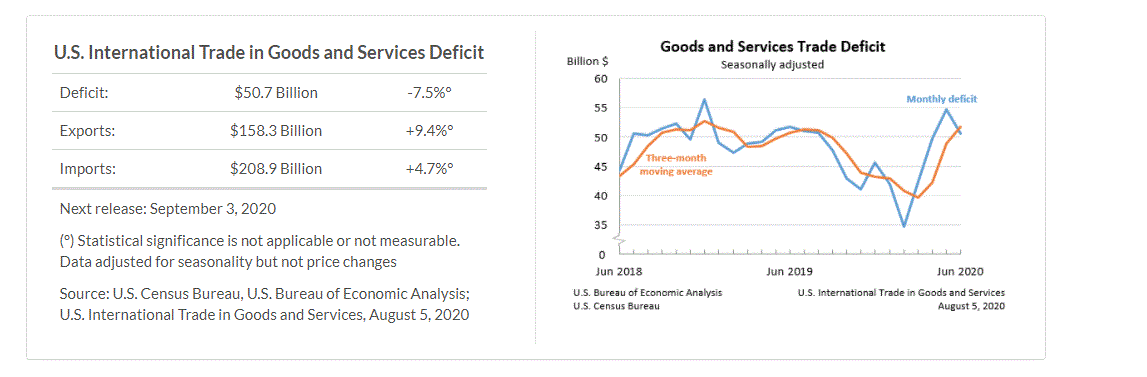
The U.S. Census Bureau and the U.S. Bureau of Economic Analysis announced today that the goods and services deficit was $50.7 billion in June, down $4.1 billion from $54.8 billion in May, revised.
Coronavirus (COVID-19) Impact on May 2020 International Trade in Goods and Services
Exports and imports increased in June following monthly declines since March that were, in part, due to the impact of COVID-19, as many businesses were operating at limited capacity or ceased operations completely, and the movement of travelers across borders was restricted. The full economic effects of the COVID-19 pandemic cannot be quantified in the trade statistics for June because the impacts are generally embedded in source data and cannot be separately identified. The Census Bureau and the Bureau of Economic Analysis have monitored data quality and determined estimates in this release meet publication standards. For more information on the impact of COVID-19 on the statistics, see the frequently asked questions on goods from the Census Bureau and on services from BEA.
Exports, Imports, and Balance (exhibit 1)
June exports were $158.3 billion, $13.6 billion more than May exports. June imports were $208.9 billion, $9.5 billion more than May imports.
The June decrease in the goods and services deficit reflected a decrease in the goods deficit of $4.0 billion to $72.2 billion and an increase in the services surplus of $0.1 billion to $21.5 billion.
Year-to-date, the goods and services deficit decreased $23.1 billion, or 7.8 percent, from the same period in 2019. Exports decreased $199.1 billion or 15.7 percent. Imports decreased $222.3 billion or 14.2 percent.
Three-Month Moving Averages (exhibit 2)
The average goods and services deficit increased $2.8 billion to $51.8 billion for the three months ending in June.
Average exports decreased $10.6 billion to $151.4 billion in June.
Average imports decreased $7.9 billion to $203.1 billion in June.
Year-over-year, the average goods and services deficit increased $1.0 billion from the three months ending in June 2019.
Average exports decreased $59.1 billion from June 2019.
Average imports decreased $58.1 billion from June 2019. Read More →
https://www.bea.gov/news/2020/us-international-trade-goods-and-services-june-2020
Proclamation on Adjusting Imports of Aluminum Into the United States
1. On January 19, 2018, the Secretary of Commerce (Secretary) transmitted to me a report on his investigation into the effect of imports of aluminum articles on the national security of the United States under section 232 of the Trade Expansion Act of 1962, as amended (19 U.S.C. 1862). The Secretary found and advised me of his opinion that aluminum articles were being imported into the United States in such quantities and under such circumstances as to threaten to impair the national security of the United States.
2. In Proclamation 9704 of March 8, 2018 (Adjusting Imports of Aluminum Into the United States), I concurred in the Secretary’s finding that aluminum articles were being imported into the United States in such quantities and under such circumstances as to threaten to impair the national security of the United States, and decided to adjust the imports of aluminum articles, as defined in clause 1 of Proclamation 9704, by imposing a 10 percent ad valorem tariff on such articles imported from most countries. I further stated that any country with which we have a security relationship is welcome to discuss with the United States alternative ways to address the threatened impairment of the national security caused by imports from that country, and noted that, should the United States and any such country arrive at a satisfactory alternative means to address the threat to the national security such that I determine that imports from that country no longer threaten to impair the national security, I may remove or modify the restriction on aluminum articles imports from that country and, if necessary, adjust the tariff as it applies to other countries as the national security interests of the United States require.
3. In Proclamation 9893 of May 19, 2019 (Adjusting Imports of Aluminum Into the United States), I noted that the United States had successfully concluded discussions with Canada on satisfactory alternative means to address the threatened impairment of the national security posed by aluminum imports from Canada. In particular, the United States agreed on a range of measures with Canada that were expected to allow imports of aluminum from Canada to remain stable at historical levels without meaningful increases, thus permitting the domestic capacity utilization to remain reasonably commensurate with the target level recommended in the Secretary’s report. These included measures to monitor for and avoid import surges.
4. In light of this agreement, I determined that, under the framework in the agreement, imports of aluminum from Canada would no longer threaten to impair the national security, and thus I decided to exclude Canada from the tariff proclaimed in Proclamation 9704, as amended. I noted that the United States would monitor the implementation and effectiveness of the measures agreed upon with Canada in addressing our national security needs, and that I may revisit this determination as appropriate.
5. In Proclamation 9704, I also directed the Secretary to monitor imports of aluminum articles and inform me of any circumstances that in the Secretary’s opinion might indicate the need for further action under section 232 of the Trade Expansion Act of 1962, as amended, with respect to such imports. Read More →