
USDA Announces OneUSDA Internship Program for Summer 2021

(Washington, D.C., November 9, 2020) – Get the first leg up on your career ladder with a summer 2021 internship at the U.S. Department of Agriculture (USDA). As part of the federal Pathways Program, USDA offers paid federal internships at USDA agencies and offices around the country. USDA is hiring interns from high school to graduate level for a broad range of occupational fields, from veterinary science, to engineering, to natural resources management, and finance.

This developmental program gives students experience to enhance their educational goals and shape their career choices. USDA internships involve on-the-job experience, mentorship, and training tailored to the student’s education, experience, and interests.

The program is available to students who are currently enrolled in qualifying educational programs or institutions from high school to graduate level.

In 2020, USDA hosted thousands of in-person and virtual internships around the country, many of which were through the federal Pathways Program. Next summer, USDA will hire Pathways interns in hundreds of locations in nearly every state in the country for the following occupational fields:

Administration and Office Support
Biological Science
Business and Industry
Engineering and Architecture
Financial Management
Information Technology
Veterinary Science

It’s easy to apply for a OneUSDA Pathways internship. Visit www.usda.gov/internships, choose your area of interest and the link will send you to a USAJobs posting where you can apply and choose your preferred location.

The deadline for summer 2021 internship applications is Monday, November 16. Application review will begin immediately. For more information on the program and eligibility, visit www.usda.gov/internships or email internship@usda.gov.

Educators, youth-serving organizations, and students can find more USDA resources to foster the next generation of agricultural professionals at www.usda.gov/youth.

###
https://www.usda.gov/media/press-releases/2020/11/09/usda-announces-oneusda-internship-program-summer-2021

USTR Announces Enforcement Action to Block Illegal Timber Imports from Peru

Washington, D.C. – Today, United States Trade Representative Robert Lighthizer directed United States Customs and Border Protection (CBP) to continue to block future timber imports from Inversiones La Oroza SRL (Oroza), a Peruvian exporter, based on illegally harvested timber found in its supply chain.  The current CBP denial of entry order against Oroza was set to expire this month.  This marks the third time that the Trump Administration has taken such an enforcement action under the United States-Peru Trade Promotion Agreement’s (PTPA) Annex on Forest Sector Governance (Forest Annex), further demonstrating its commitment to keeping illegal timber out of the United States and enforcing our trade agreements.  

“President Trump takes seriously and is prioritizing enforcement of our trade agreements,” said Ambassador Lighthizer.  “We remain committed to trade and investment that accelerates economic growth and simultaneously protects the environment.  We will continue to monitor Peru’s compliance with its obligations under our trade agreement to ensure that illegally-harvest timber cannot be exported to the United States.”

Background

The PTPA contains an enforceable Environment Chapter and Forest Annex, which includes a requirement for Peru to conduct audits of particular timber producers and exporters, and upon request from the United States, perform verifications of particular shipments of wood products.  The Interagency Committee on Trade in Timber Products from Peru (Timber Committee) monitors Peru’s compliance with the PTPA’s requirements.  In 2016, the Timber Committee requested that Peru verify that a specific timber shipment from Oroza complied with all applicable Peruvian laws and regulations.  The verification process conducted by Peru revealed that significant portions of the Oroza shipment were not compliant with the applicable laws and regulations governing the harvest of and trade in timber products. 

As a result of the verification process, in October 2017, the Trump Administration took unprecedented action to deny entry of timber products and exports by Oroza.  To date, however, the Government of Peru has not demonstrated to the satisfaction of the Timber Committee that Oroza is compliant with the necessary requirements for the harvest of and trade in timber products.

As this action demonstrates, while the Forest Annex has catalyzed meaningful reforms in Peru’s forestry sector, significant work remains for Peru to address its ongoing challenges to combat illegal logging.  The United States and Peru continue to engage in a cooperative and meaningful way to combat illegal logging and work toward improving forest sector governance.  USTR and the Timber Committee will continue to monitor Peru’s implementation of the commitments in the Environment Chapter.  

For additional information on the PTPA Forest Annex, please click here.

###

https://ustr.gov/about-us/policy-offices/press-office/press-releases/2020/october/ustr-announces-enforcement-action-block-illegal-timber-imports-peru

USTR and USDA Release Report on Agricultural Trade between the United States and China

Washington, DC – The Office of the U.S. Trade Representative (USTR) and the U.S. Department of Agriculture (USDA) today issued a report highlighting the progress made to date in implementing the agricultural provisions in the U.S.-China Phase One Economic and Trade Agreement, which is delivering historic results for American agriculture.

Since the Agreement entered into force, the United States and China have addressed a multitude of structural barriers in China that had been impeding exports of U.S. food and agricultural products. To date, China has implemented at least 50 of the 57 technical commitments under the Phase One Agreement. These structural changes will benefit American farmers for decades to come. China also has substantially ramped up its purchases of U.S. agricultural products. To date, China has purchased over $23 billion in agricultural products, approximately 71% of its target under the Phase One Agreement. Highlights outlined in the report include:

  • Corn: Outstanding sales of U.S. corn to China are at an all-time high of 8.7 million tons.

  • Soybeans: U.S. soybeans sales for marketing year 2021 are off to the strongest start in history, with outstanding sales to China double 2017 levels.

  • Sorghum: U.S. exports of sorghum to China from January to August 2020 totaled $617 million, up from $561 million for the same period in 2017.

  • Pork: U.S. pork exports to China hit an all-time record in just the first five months of 2020.

  • Beef: U.S. beef and beef products exports to China through August 2020 are already more than triple the total for 2017.

In addition to these products, USDA expects 2020 sales to China to hit record or near-record levels for numerous other U.S. agricultural products including pet food, alfalfa hay, pecans, peanuts, and prepared foods.

"This China Phase One Agreement is proof President Trump’s negotiating strategy is working. While it took China a long time to realize President Trump was serious, this deal is a huge success for the entire economy. This agreement finally levels the playing field for U.S. agriculture and is a bonanza for America’s farmers, ranchers, and producers," said U.S. Secretary of Agriculture Sonny Perdue. "Being able to participate in this market in a more fair and equitable way has generated more sales that are supporting higher prices and strengthening the rural economy."

"President Trump delivered on his promise to confront China’s unfair trade practices and expand market opportunities for U.S. agriculture through the Phase One Agreement. Since the Agreement entered into force eight months ago, we have seen remarkable improvements in our agricultural trade relationship with China, which will benefit our farmers and ranchers for years to come," said U.S. Trade Representative Robert Lighthizer.

USTR and USDA continue to work closely with the Chinese government to ensure that the Phase One Agreement is fully and properly implemented, so that access for U.S. food and agricultural products into the Chinese market can continue to expand moving forward.

The report is available here.

###

https://ustr.gov/about-us/policy-offices/press-office/press-releases/2020/october/ustr-and-usda-release-report-agricultural-trade-between-united-states-and-china

USTR Announces GSP Enforcement Action, Country Successes, and New Eligibility Reviews

Washington, DC – The Office of the United States Trade Representative (USTR) announced today that President Trump is suspending $817 million in trade preferences for Thailand under the Generalized System of Preferences (GSP) program based on its lack of sufficient progress providing the United States with equitable and reasonable market access for pork products.  

USTR also announced the closure of GSP eligibility reviews with no loss of benefits for three countries: Georgia, based on improvements in the protection of worker rights; Uzbekistan, also based on improvements in the protection of worker rights; and Indonesia, based on improvements aimed at providing the United States with equitable and reasonable market access.  USTR also announced the closure of the GSP designation review of Laos with no change in status and the opening of two new GSP eligibility reviews of Eritrea and Zimbabwe, based on worker rights concerns.  

“Today’s announcement demonstrates the effective use of the GSP program to improve labor standards and help U.S. businesses and workers succeed,” said U.S. Trade Representative Robert E. Lighthizer.  “It also demonstrates the Trump Administration’s commitment to robust monitoring and enforcement of our trade preference programs and underscores that when countries do not meet the congressionally mandated eligibility criteria, we will take action by limiting their preferential duty-free access to the U.S. market.” 

USTR also announced the results of the GSP annual product review, including addition of fresh-cut roses to, and removal of parboiled rice from, the list of goods eligible for GSP trade benefits.  

Background 

GSP, the largest and oldest U.S. trade preference program, is designed to promote economic development by allowing duty-free entry into the United States for 3,500 products from the 119 designated beneficiary countries and territories.  To remain eligible for these advantages, beneficiary countries must comply with 15 statutory eligibility criteria, including taking steps to afford internationally recognized worker rights, providing adequate and effective protection of intellectual property rights, and assuring equitable and reasonable access to its markets. 

Today’s announcement represents the culmination of three separate processes under the GSP program: determinations on ongoing GSP eligibility reviews of beneficiary countries, based on stakeholder petitions or self-initiation of reviews by USTR; triennial assessments of all beneficiary developing countries in the Middle East, North Africa, and sub-Saharan Africa to determine whether to launch new GSP eligibility reviews; and the annual GSP product review, which provides stakeholders the opportunity to request the addition of products to, and/or removal of products from, the list of goods eligible for duty-free treatment under GSP. Read More→

https://ustr.gov/about-us/policy-offices/press-office/press-releases/2020/october/ustr-announces-gsp-enforcement-action-country-successes-and-new-eligibility-reviews

USITC INSTITUTES SECTION 337 INVESTIGATION OF CERTAIN AUTOMATED STORAGE AND RETRIEVAL SYSTEMS, ROBOTS, AND COMPONENTS THEREO

The U.S. International Trade Commission (USITC) has voted to institute an investigation of certain automated storage and retrieval systems, robots, and components thereof.  The products at issue in the investigation are described in the Commission’s notice of investigation.

The investigation is based on a complaint filed by AutoStore Technology AS and AutoStore AS, both of Nedre Vats, Norway, and AutoStore System Inc. of Derry, NH, on October 1, 2020.  The complaint alleges violations of section 337 of the Tariff Act of 1930 in the importation into the United States and sale of certain automated storage and retrieval systems, robots, and components thereof that infringe patents asserted by the complainants.  The complainants request that the USITC issue a limited exclusion order and cease and desist orders. 

The USITC has identified the following as respondents in this investigation:

Ocado Group Plc of Hatfield, Hertfordshire, United Kingdom;
Ocado Central Services Ltd. of Hatfield, Hertfordshire, United Kingdom;
Ocado Innovation Ltd. of Hatfield, Hertfordshire, United Kingdom;
Ocado Operating Ltd. of Hatfield, Hertfordshire, United Kingdom;
Ocado Solutions, Ltd., of Hatfield, Hertfordshire, United Kingdom;
Ocado Solutions USA Inc. of Tysons Corner, VA;
Tharsus Group Ltd. of Blyth, Northumberland, United Kingdom; and
Printed Motor Works Ltd. of Alton, Hampshire, United Kingdom.

By instituting this investigation (337-TA-1228), the USITC has not yet made any decision on the merits of the case.  The USITC’s Chief Administrative Law Judge will assign the case to one of the USITC’s administrative law judges (ALJ), who will schedule and hold an evidentiary hearing.  The ALJ will make an initial determination as to whether there is a violation of section 337; that initial determination is subject to review by the Commission.

The USITC will make a final determination in the investigation at the earliest practicable time.  Within 45 days after institution of the investigation, the USITC will set a target date for completing the investigation.  USITC remedial orders in section 337 cases are effective when issued and become final 60 days after issuance unless disapproved for policy reasons by the U.S. Trade Representative within that 60-day period.

# # #

https://www.usitc.gov/press_room/news_release/2020/er1102ll1667.htm

USITC MAKES DETERMINATION IN FIVE-YEAR (SUNSET) REVIEW CONCERNING FROZEN FISH FILLETS FROM VIETNAM

The U.S. International Trade Commission (USITC) today determined that revoking the existing antidumping duty order on imports of frozen fish fillets from Vietnam would be likely to lead to continuation or recurrence of material injury within a reasonably foreseeable time. 

As a result of the Commission’s affirmative determination, the existing order on imports of this product from Vietnam will remain in place. 

Chair Jason E. Kearns, Vice Chair Randolph J. Stayin, and Commissioners David S. Johanson, Rhonda K. Schmidtlein, and Amy A. Karpel voted in the affirmative.

Today’s action comes under the five-year (sunset) review process required by the Uruguay Round Agreements Act.  See the attached page for background on this five-year (sunset) review.

The Commission’s public report Frozen Fish Fillets from Vietnam (Inv. No. 731-TA-1012 (Third Review), USITC Publication 5135, November 2020) will contain the views of the Commission and information developed during the review.

The report will be available by December 10, 2020; when available, it may be accessed on the USITC website at: https://www.usitc.gov/commission_publications_library. Read More→

https://www.usitc.gov/press_room/news_release/2020/er1029ll1666.htm

USTR and USDA Release Report on Agricultural Trade between the United States and China

Washington, DC – The Office of the U.S. Trade Representative (USTR) and the U.S. Department of Agriculture (USDA) today issued a report highlighting the progress made to date in implementing the agricultural provisions in the U.S.-China Phase One Economic and Trade Agreement, which is delivering historic results for American agriculture.

Since the Agreement entered into force, the United States and China have addressed a multitude of structural barriers in China that had been impeding exports of U.S. food and agricultural products. To date, China has implemented at least 50 of the 57 technical commitments under the Phase One Agreement. These structural changes will benefit American farmers for decades to come. China also has substantially ramped up its purchases of U.S. agricultural products. To date, China has purchased over $23 billion in agricultural products, approximately 71% of its target under the Phase One Agreement. Highlights outlined in the report include:


  • Corn: Outstanding sales of U.S. corn to China are at an all-time high of 8.7 million tons.

  • Soybeans: U.S. soybeans sales for marketing year 2021 are off to the strongest start in history, with outstanding sales to China double 2017 levels.

  • Sorghum: U.S. exports of sorghum to China from January to August 2020 totaled $617 million, up from $561 million for the same period in 2017.

  • Pork: U.S. pork exports to China hit an all-time record in just the first five months of 2020.

  • Beef: U.S. beef and beef products exports to China through August 2020 are already more than triple the total for 2017.


In addition to these products, USDA expects 2020 sales to China to hit record or near-record levels for numerous other U.S. agricultural products including pet food, alfalfa hay, pecans, peanuts, and prepared foods.

"This China Phase One Agreement is proof President Trump’s negotiating strategy is working. While it took China a long time to realize President Trump was serious, this deal is a huge success for the entire economy. This agreement finally levels the playing field for U.S. agriculture and is a bonanza for America’s farmers, ranchers, and producers," said U.S. Secretary of Agriculture Sonny Perdue. "Being able to participate in this market in a more fair and equitable way has generated more sales that are supporting higher prices and strengthening the rural economy."

"President Trump delivered on his promise to confront China’s unfair trade practices and expand market opportunities for U.S. agriculture through the Phase One Agreement. Since the Agreement entered into force eight months ago, we have seen remarkable improvements in our agricultural trade relationship with China, which will benefit our farmers and ranchers for years to come," said U.S. Trade Representative Robert Lighthizer.

USTR and USDA continue to work closely with the Chinese government to ensure that the Phase One Agreement is fully and properly implemented, so that access for U.S. food and agricultural products into the Chinese market can continue to expand moving forward.

The report is available here.

United States and Brazil Update Agreement on Trade and Economic Cooperation with New Protocol on Trade Rules and Transparency

Washington, D.C. – Today, the United States and Brazil signed a new Protocol relating to Trade Rules and Transparency.  This Protocol updates the 2011 Agreement on Trade and Economic Cooperation (ATEC) with three new annexes comprising state-of-the-art provisions on Customs Administration and Trade Facilitation, Good Regulatory Practices, and Anticorruption.

“From their first meetings, President Trump and President Bolsonaro have shared a vision for a prosperity partnership between the United States and Brazil and a desire for new trade initiatives.  Today’s Protocol uses the existing ATEC to establish common standards for the two countries on efficient customs procedures, transparent regulatory development, and robust anti-corruption policies that will create a strong foundation for closer economic ties between our two countries,” stated Ambassador Robert Lighthizer.

The ATEC allows engagement on a wide range of issues related to trade and investment.  As the United States and Brazil implement today’s Protocol, they will also continue to explore ways to increase trade in goods and services and encourage further investment.

Background

U.S. goods and services trade with Brazil totaled an estimated $105.1 billion in 2019. Exports were $67.4 billion; imports were $37.6 billion. The U.S. goods and services trade surplus with Brazil was $29.8 billion in 2019.

Brazil is currently our 14th largest goods trading partner with $73.7 billion in total (two way) goods trade during 2019. Goods exports totaled $42.9 billion; goods imports totaled $30.8 billion. The U.S. goods trade surplus with Brazil was $12.0 billion in 2019.

The full text of the U.S.-Brazil ATEC Protocol on Trade Rules and Transparency can be found here.

An additional joint statement by the United States and Brazil can be found here.

A fact sheet on the Protocol can be found here.

###

USITC INSTITUTES SECTION 337 INVESTIGATION OF CERTAIN ARTIFICIAL EYELASH EXTENSION SYSTEMS, PRODUCTS, AND COMPONENTS THEREOF

The U.S. International Trade Commission (USITC) has voted to institute an investigation of certain artificial eyelash extension systems, products, and components thereof.  The products at issue in the investigation are described in the Commission’s notice of investigation.

The investigation is based on a complaint filed by Lashify, Inc., of Glendale, CA, on September 10, 2020.  The complaint alleges violations of section 337 of the Tariff Act of 1930 in the importation into the United States and sale of certain artificial eyelash extension systems, products, and components thereof that infringe patents asserted by the complainant.  The complainant requests that the USITC issue a general exclusion order, or in the alternative a limited exclusion order, and cease and desist orders. 

The USITC has identified the following as respondents in this investigation:

KISS Nail Products, Inc., of Port Washington, NY;
Ulta Beauty, Inc., of Bolingbrook, IL;
Walmart, Inc., of Bentonville, AR;
CVS Health Corporation of Woonsocket, RI;
Qingdao Hollyren Cosmetics Co., Ltd. d/b/a Hollyren of Shandong Province, China;
Qingdao Xizi International Trading Co., Ltd. d/b/a Xizi Lashes of Shandong Province, China;
Qingdao LashBeauty Cosmetic Co., Ltd. d/b/a Worldbeauty of Qingdao, China;
Alicia Zeng d/b/a Lilac St; Artemis Family Beginnings, Inc., of San Francisco, CA; and
Rachael Gleason d/b/a Avant Guard Beauty Co. of Dallas TX.

By instituting this investigation (337-TA-1226), the USITC has not yet made any decision on the merits of the case.  The USITC’s Chief Administrative Law Judge will assign the case to one of the USITC’s administrative law judges (ALJ), who will schedule and hold an evidentiary hearing.  The ALJ will make an initial determination as to whether there is a violation of section 337; that initial determination is subject to review by the Commission.

The USITC will make a final determination in the investigation at the earliest practicable time.  Within 45 days after institution of the investigation, the USITC will set a target date for completing the investigation.  USITC remedial orders in section 337 cases are effective when issued and become final 60 days after issuance unless disapproved for policy reasons by the U.S. Trade Representative within that 60-day period.

# # #

USITC INSTITUTES SECTION 337 INVESTIGATION OF CERTAIN ROUTERS, ACCESS POINTS, CONTROLLERS, NETWORK MANAGEMENT DEVICES, OTHER NETWORKING PRODUCTS, AND HARDWARE AND SOFTWARE COMPONENTS THEREOF

The U.S. International Trade Commission (USITC) has voted to institute an investigation of certain routers, access points, controllers, network management devices, other networking products, and hardware and software components thereof.  The products at issue in the investigation are described in the Commission’s notice of investigation.

The investigation is based on a complaint filed by Q3 Networking LLC of Frisco, TX, on September 22, 2020.  The complaint alleges violations of section 337 of the Tariff Act of 1930 in the importation into the United States and sale of certain routers, access points, controllers, network management devices, other networking products, and hardware and software components thereof that infringe patents asserted by the complainant.  The complainant requests that the USITC issue a limited exclusion order and cease and desist orders. 

The USITC has identified the following as respondents in this investigation:

CommScope Holding Company, Inc., of Hickory, NC;
CommScope, Inc., of Hickory, NC;
Arris US Holdings, Inc., of Suwanee, GA;
Ruckus Wireless, Inc., of Sunnyvale, CA;
Hewlett Packard Enterprise Co. of Palo Alto, CA;
Aruba Networks, Inc., of Santa Clara, CA; and
Netgear, Inc., of San Jose, CA.

By instituting this investigation (337-TA-1227), the USITC has not yet made any decision on the merits of the case.  The USITC’s Chief Administrative Law Judge will assign the case to one of the USITC’s administrative law judges (ALJ), who will schedule and hold an evidentiary hearing.  The ALJ will make an initial determination as to whether there is a violation of section 337; that initial determination is subject to review by the Commission.

The USITC will make a final determination in the investigation at the earliest practicable time.  Within 45 days after institution of the investigation, the USITC will set a target date for completing the investigation.  USITC remedial orders in section 337 cases are effective when issued and become final 60 days after issuance unless disapproved for policy reasons by the U.S. Trade Representative within that 60-day period.

# # #

USITC INSTITUTES SECTION 337 INVESTIGATION OF CERTAIN SHINGLED SOLAR MODULES, COMPONENTS THEREOF, AND METHODS FOR MANUFACTURING THE SAME

The U.S. International Trade Commission (USITC) has voted to institute an investigation of certain shingled solar modules, components thereof, and methods for manufacturing the same.  The products at issue in the investigation are described in the Commission’s notice of investigation.

The investigation is based on a complaint filed by The Solaria Corporation of Fremont, CA, on September 15, 2020.  The complaint alleges violations of section 337 of the Tariff Act of 1930 in the importation into the United States and sale of certain shingled solar modules, components thereof, and methods for manufacturing the same that infringe patents asserted by the complainant.  The complainant requests that the USITC issue a limited exclusion order and cease and desist orders. 

The USITC has identified the following as respondents in this investigation:

Canadian Solar Inc. of Guelph, Ontario, Canada; and
Canadian Solar (USA) Inc. of Walnut Creek, CA.

By instituting this investigation (337-TA-1223), the USITC has not yet made any decision on the merits of the case.  The USITC’s Chief Administrative Law Judge will assign the case to one of the USITC’s administrative law judges (ALJ), who will schedule and hold an evidentiary hearing.  The ALJ will make an initial determination as to whether there is a violation of section 337; that initial determination is subject to review by the Commission.

The USITC will make a final determination in the investigation at the earliest practicable time.  Within 45 days after institution of the investigation, the USITC will set a target date for completing the investigation.  USITC remedial orders in section 337 cases are effective when issued and become final 60 days after issuance unless disapproved for policy reasons by the U.S. Trade Representative within that 60-day period.

# # #

https://www.usitc.gov/press_room/news_release/2020/er1016ll1658.htm

USITC MAKES DETERMINATIONS IN FIVE-YEAR (SUNSET) REVIEWS CONCERNING PRESTRESSED CONCRETE STEEL WIRE STRAND FROM BRAZIL, INDIA, JAPAN, KOREA, MEXICO, AND THAILAND

The U.S. International Trade Commission (USITC) today determined that revoking the existing antidumping and countervailing duty orders on imports of prestressed concrete steel wire strand from Brazil, India, Japan, Korea, Mexico, and Thailand would be likely to lead to continuation or recurrence of material injury within a reasonably foreseeable time. 

As a result of the Commission’s affirmative determinations, the existing orders on imports of these products from Brazil, India, Japan, Korea, Mexico, and Thailand will remain in place. 

Chair Jason E. Kearns, Vice Chair Randolph J. Stayin, and Commissioners David S. Johanson, Rhonda K. Schmidtlein, and Amy A. Karpel voted in the affirmative.

Today’s action comes under the five-year (sunset) review process required by the Uruguay Round Agreements Act.  See the attached page for background on these five-year (sunset) reviews.

The Commission’s public report Prestressed Concrete Steel Wire Strand from Brazil, India, Japan, Korea, Mexico, and Thailand (Inv. Nos. 701-TA-432 and 731-TA-1024-1028 (Third Review) and AA1921-188 (Fifth Review), USITC Publication 5130, October 2020) will contain the views of the Commission and information developed during the reviews.

The report will be available by November 18, 2020; when available, it may be accessed on the USITC website at: https://www.usitc.gov/commission_publications_library.

BACKGROUND

The Uruguay Round Agreements Act requires the Department of Commerce to revoke an antidumping or countervailing duty order, or terminate a suspension agreement, after five years unless the Department of Commerce and the USITC determine that revoking the order or terminating the suspension agreement would be likely to lead to continuation or recurrence of dumping or subsidies (Commerce) and of material injury (USITC) within a reasonably foreseeable time.

The Commission’s institution notice in five-year reviews requests that interested parties file responses with the Commission concerning the likely effects of revoking the order under review as well as other information.  Generally within 95 days from institution, the Commission will determine whether the responses it has received reflect an adequate or inadequate level of interest in a full review.  If responses to the USITC’s notice of institution are adequate, or if other circumstances warrant a full review, the Commission conducts a full review, which includes a public hearing and issuance of questionnaires.

The Commission generally does not hold a hearing or conduct further investigative activities in expedited reviews.  Commissioners base their injury determination in expedited reviews on the facts available, including the Commission’s prior injury and review determinations, responses received to its notice of institution, data collected by staff in connection with the review, and information provided by the Department of Commerce.

The five-year (sunset) reviews concerning Prestressed Concrete Steel Wire Strand from Brazil, India, Japan, Korea, Mexico, and Thailand were instituted on March 2, 2020.

On June 5, 2020, the Commission voted to conduct expedited reviews. Commissioners David S. Johanson, Rhonda K. Schmidtlein, Jason E. Kearns, Randolph J. Stayin, and Amy A. Karpel concluded that the domestic group response was adequate and the respondent group responses were inadequate and voted for expedited reviews.

A record of the Commission’s vote to conduct expedited reviews is available from the Office of the Secretary, U.S. International Trade Commission, 500 E Street SW, Washington, DC 20436.  Requests may be made by telephone by calling 202-205-1802.

# # #

https://www.usitc.gov/press_room/news_release/2020/er1016ll1659.htm

U.S. – Mexico – Canada Agreement (USMCA) Overview

Overview

The U.S. – Mexico – Canada Agreement (USMCA) is a trade agreement between the named parties.  The USMCA replaced the North American Free Trade Agreement (NAFTA). 

U.S. Customs and Border Protection (CBP) has launched a USMCA Center to serve as a one stop shop for information concerning the USMCA. The USMCA Center coordinates CBP’s implementation of the USMCA Agreement, ensuring a smooth transition with consistent and comprehensive guidance to our internal and external stakeholders.

USMCA Resource Center

Entry-into Force

  • The USMCA entered into force on July 1, 2020. NAFTA preferential treatment cannot be claimed on July 1, 2020 or afterwards.

  • For merchandise entered into commerce on or before June 30, 2020, NAFTA rules will continue to apply.

Uniform Regulations, General Note,  and Implementation Instructions - Final (as of June 30, 2020)

On April 20, 2020, CBP published interim implementing instructions. These interim implementing instruction have been subsequently updated to reflect the published uniform regulations and General Note 11.  

  Compliance Guidance

  • CBP will use this webpage to post informational links, compliance guidance materials, points of contact, and Frequently Asked Questions.  Additional guidance on USMCA compliance for the trade community will be posted here as developed. This webpage will be continually updated.

  • CBP has recorded a webinar regarding USMCA compliance for the private sector.  Please visit CBP’s Trade Outreach via Webinar webpage for more information.

  • CBP urges the import/export community to monitor CBP.gov/Trade, the Cargo System Messaging Service, and @CBPTradeGov on Twitter for updates on USMCA implementation dates; regulatory drafting; Frequently Asked Questions and other compliance resources.

  • The USMCA contains provisions relating to the prohibition of the importation of goods sourced from forced labor. For additional information on CBP’s enforcement against this prohibition, please visit our Forced Labor webpage. Read More→

https://www.cbp.gov/trade/priority-issues/trade-agreements/free-trade-agreements/USMCA

CBP Trade Statistics

Trade Statistics

CBP has the critical responsibility to enforce U.S. trade laws prior to merchandise arriving at U.S. ports of entry, once merchandise arrives at our ports, and even after merchandise is released into the U.S. marketplace. Among other critical mission sets,  CBP is charged with balancing the facilitation of legitimate trade that supports economic growth with the duty to shield the American public and businesses from unsafe products, intellectual property theft, and unfair trade practices.

To enforce trade laws effectively and minimize the unnecessary slowing of trade, CBP leverages its expertise to identify the highest-risk imports prior to release. In the post-release environment, CBP utilizes a sophisticated system of reviews and audits to verify import compliance and accurate revenue collection. CBP expertly applies an increasing number of complex U.S. and international trade laws and when CBP detects a discrepancy, actions are taken to address the violation and deter future non-compliance.

To accomplish comprehensive, agile, and uniform enforcement, CBP employs a national trade enforcement program that offers a framework for national collaboration within CBP and among other government agencies and multinational partners.

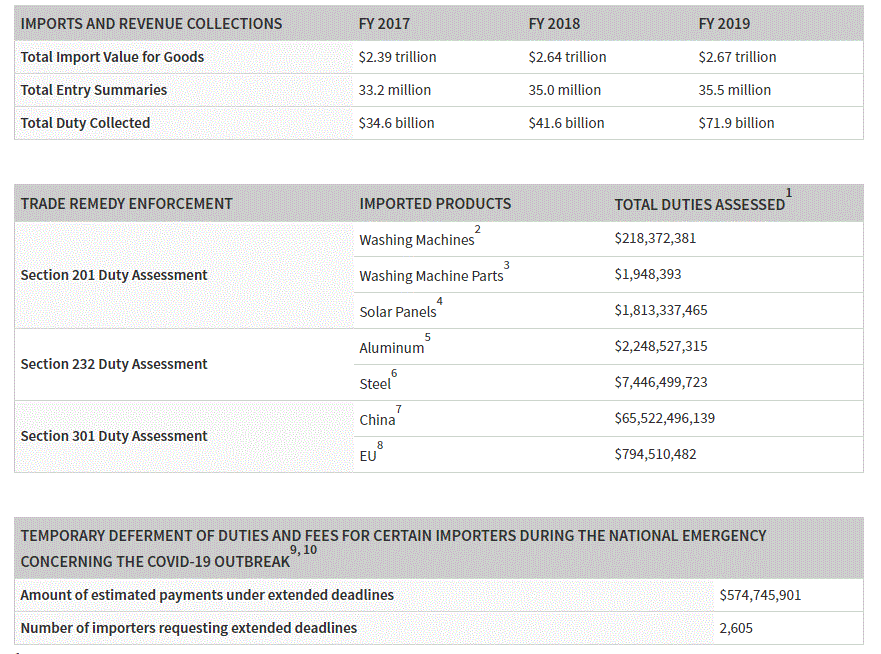
The below data is only a snapshot of CBP's critical trade mission. It summarizes CBP's revenue collection efforts; implementation of the recent trade remedies taken pursuant to Section 232 of the Trade Expansion Act of 1962 and Sections 201 and 301 of the Trade Act of 1974; and trade enforcement actions.

For more information, please visit the Trade section of CBP.gov.

CBP TRADE STATISTICS*

Published by the U.S. Customs and Border Protection

Published by the U.S. Customs and Border Protection

Importing COVID-19 Supplies

IMPORTERS: Shipment of COVID-19 supplies held-up at a port-of-entry?

For assistance, contact the FDA office covering your port of entry.

Visit the FDA Import Offices and Ports of Entry page for contact information and instructions. It includes an interactive map that importers can use to find the right office for their shipment and based on where the product is entering the United States.

To speed assistance to importers during the COVID-19 pandemic with an urgent need of COVID-19 supplies, please have the necessary information available, such as the:

  • entry number (which you can get from your entry filer),

  • port of entry, and

  • other shipment details.

The FDA receives many different types of entries (consumption, informal, warehouse, import for export, etc.). Most questions revolve around the difference between commercial and personal shipments. 

For assistance, with import procedures regarding personal protective equipment or test kits, email:

COVID19FDAImportInquiries@fda.hhs.gov Read More→  

https://www.fda.gov/industry/import-program-food-and-drug-administration-fda/importing-covid-19-supplies

FDA Actions & Enforcement

FDA-regulated products imported into the U.S. must comply with FDA laws and regulations. FDA enforces the Federal Food, Drug and Cosmetic Act (FD&C Act) and other related acts.  This page provides an overview of FDA’s import compliance and enforcement activities at the point of entry.

FDA has jurisdiction over imported products at the time of entry but also after the products have entered domestic commerce.

For more information on what FDA regulates visit FDA Basics.

Below is a list of actions, enforcement and compliance activities that FDA may take:

  • Examination & Sample Collection
    FDA is authorized to examine and collect samples of FDA-regulated products offered for entry into the U.S.  If the FDA decides to examine or sample your products, a Notice of FDA Action will be issued to the importer of record, consignee, and filer. It is your responsibility to notify the FDA office handling your entry that your products are available for examination. The FDA office handling your entry is identified on the Notice of FDA Action.  Once the location of  your products is provided, FDA will arrange to examine the products.  Products pending FDA examination or sample collection must be held and should not be distributed into commerce until results are evaluated and the products are released. Failure to hold your products might result in FDA requesting Customs and Border Protection (CBP) to demand redelivery.
     

  • Detention & Hearing 
    If the product appears to be in violation, the product is subject to refusal and a Notice of FDA Action will be issued. The notice will specify the nature of the violation and provide the importer an opportunity to present supporting evidence to overcome the violation, within a specified time period.  The importer can request an extension if additional time is needed to collect or present the information. 
     

  • Import Alerts
    Import alerts inform FDA field staff that the agency has enough evidence or other information to allow for Detention Without Physical Examination (DWPE) of products subject to an import alert.  Products are subject to DWPE based upon past violations. These violations could be related to the product, manufacturer, shipper and/or other information indicating the product may be in violation of FDA laws. Depending on the specific import alert, products can still be imported into the U.S. if the importer has demonstrated that the product is in compliance.  Before shipping to the U.S., importers should be aware of whether or not the product is subject to DWPE.  Additionally, import alerts:

    • Prevent potential violative products from being distributed into the U.S.

    • Free up agency resources to examine other products

    • Provide uniform coverage across the country

    • Place the responsibility back on the importer. (It is the responsibility of the importer to ensure that the products being imported into the U.S. are in compliance with FDA laws and regulations.)

    FDA has more than 200 active import alerts that prevent potentially violative products from entering U.S. commerce. Read More→  

    https://www.fda.gov/industry/import-program-food-and-drug-administration-fda/actions-enforcement

USITC INSTITUTES SECTION 337 INVESTIGATION OF CERTAIN VIDEO PROCESSING DEVICES, COMPONENTS THEREOF, AND DIGITAL SMART TELEVISIONS CONTAINING THE SAME

The U.S. International Trade Commission (USITC) has voted to institute an investigation of certain video processing devices, components thereof, and digital smart televisions containing the same.  The products at issue in the investigation are described in the Commission’s notice of institution of investigation.

The investigation is based on a complaint filed by DivX, LLC, of San Diego, CA, on September 10, 2020.  The complaint alleges violations of section 337 of the Tariff Act of 1930 in the importation into the United States and sale of certain video processing devices, components thereof, and digital smart televisions containing the same that infringe patents asserted by the complainant.  The complainant requests that the USITC issue a limited exclusion order and cease and desist orders. 

The USITC has identified the following as respondents in this investigation:

Samsung Electronics Co., Ltd., of Suwon-si, Gyeonggi-do, Rep. of Korea;
Samsung Electronics America, Inc., of Ridgefield Park, NJ;
Samsung Electronics HCMC CE Complex, Co., Ltd., of Ho Chi Minh City, Vietnam;
LG Electronics Inc. of Seoul, Rep. of Korea;
LG Electronics USA, Inc., of Englewood Cliffs, NJ;
TCL Corporation of Huizhou, Guangdong, China;
TCL Technology Group Corporation of Huizhou, Guangdong, China;
TCL Electronics Holdings Limited of Shenzhen, Guangdong, China;
TTE Technology, Inc., Corona, CA;
Shenzhen TCL New Technologies Co. Ltd. of Shenzhen, Guangdong, China;
TCL King Electrical Appliances (Huizhou) Co. Ltd. of Huizhou, Guangdong, China;
TCL MOKA International Limited of Sha Tin, New Territories, Hong Kong;
TCL Smart Device (Vietnam) Co., Ltd., of Binh Duong Province, Vietnam;
MediaTek Inc. of Hsinchu City, Taiwan;
MediaTek USA Inc. of San Jose, CA;
MStar Semiconductor, Inc., of ChuPei City, Hsinchu Hsien, Taiwan; and
Realtek Semiconductor Corp. of Hsinchu, Taiwan.

By instituting this investigation (337-TA-1222), the USITC has not yet made any decision on the merits of the case.  The USITC’s Chief Administrative Law Judge will assign the case to one of the USITC’s administrative law judges (ALJ), who will schedule and hold an evidentiary hearing.  The ALJ will make an initial determination as to whether there is a violation of section 337; that initial determination is subject to review by the Commission.

The USITC will make a final determination in the investigation at the earliest practicable time.  Within 45 days after institution of the investigation, the USITC will set a target date for completing the investigation.  USITC remedial orders in section 337 cases are effective when issued and become final 60 days after issuance unless disapproved for policy reasons by the U.S. Trade Representative within that 60-day period.

###

https://www.usitc.gov/press_room/news_release/2020/er1014ll1656.htm

Procedures To Grant Relief From the Quantitative Limitation Applicable to Certain Steel Articles for Brazil for Parties With Preexisting Contracts That Meet Specified Criteria

AGENCY:

Bureau of Industry and Security, U.S. Department of Commerce.

ACTION:

Temporary final rule.

SUMMARY:

This temporary final rule establishes procedures to grant relief from the quantitative limitation applicable to certain steel articles for Brazil for parties with preexisting contracts that meet specified criteria as authorized by the President as part of the action he took to adjust imports under Section 232 of the Trade Expansion Act of 1962, as amended (“section 232”).

DATES:

Effective date: This temporary final rule is effective October 13, 2020, through December 31, 2020.

See SUPPLEMENTARY INFORMATION section for information on submitting certifications for relief from the quantitative limitation for Brazil for steel articles.

ADDRESSES:

All certifications for relief from the quantitative limitation for Brazil for steel articles on this temporary final rule must be submitted through the email: steel232-exp@bis.doc.gov.

FOR FURTHER INFORMATION CONTACT:

For questions regarding this temporary final rule, contact Erika Maynard at 202-482-5572 or via email Erika.Maynard@bis.doc.gov, or to steel232-exp@bis.doc.gov.

SUPPLEMENTARY INFORMATION:

Background

On August 28, 2020, President Trump issued Proclamation 10064 (85 FR 54877), Adjusting Imports of Steel Into the United States, which lowered one of the section 232 quantitative limitations applicable to Brazil for the remainder of 2020 and added a new basis for relief from those lowered quantitative limitations. The President determined that the modification to the quantitative limitations applicable to certain steel products was necessary to preserve the effectiveness of the alternative means to address the threatened impairment of national security posed by steel article imports which were previously agreed to with Brazil. This temporary final rule implements the President's directive to the Secretary of Commerce (Secretary) to grant relief from the modified quantitative limitations in a limited aggregate amount under specific circumstances related to the fulfillment of existing contracts. Read More→  

https://www.federalregister.gov/documents/2020/10/13/2020-22608/procedures-to-grant-relief-from-the-quantitative-limitation-applicable-to-certain-steel-articles-for

Ambassador Robert Lighthizer Issues Statement Concerning the Caribbean Basin Economic Recovery Act

10/13/2020

Washington, D.C. – Ambassador Robert Lighthizer issued the following statement today concerning the Caribbean Basin Economic Recovery Act:

“President Trump’s October 10 action to reauthorize certain provisions of the Caribbean Basin Economic Recovery Act (CBERA) will help to preserve well-paying jobs in the U.S. textile industry while also strengthening our trade ties with Caribbean beneficiary countries, especially Haiti.  Importantly, CBERA’s eligibility criteria also provide a means to promote more open markets, protection of intellectual property rights, and stronger worker rights in beneficiary countries.”

Background

The Caribbean Basin Economic Recovery Act was launched in 1983 to facilitate economic development and promote economic diversification in the Caribbean region by providing duty-free access to the U.S. market for certain goods from Caribbean beneficiary countries.  In 2000, the Caribbean Basin Trade Partnership Act (CBTPA) expanded this access to additional goods not covered under CBERA including apparel, petroleum products, and some agricultural products.  The legislation signed by President Trump extends the CBTPA provisions of CBERA through September 30, 2030.  CBTPA is unique among U.S. trade preference programs in that it requires the use of U.S.-manufactured yarns or fabrics in finished apparel goods eligible for trade benefits, supporting many jobs in the U.S. textile sector.  The eligibility criteria under CBERA and CBTPA require that beneficiary countries meet certain requirements including 1) providing equitable and reasonable access to the markets and basic commodity resources of the country, 2) protection of intellectual property rights, and 3) taking steps to afford internationally recognized worker rights to their workers.  CBTPA beneficiary countries are Barbados, Belize, Curacao, Guyana, Haiti, Jamaica, St. Lucia, and Trinidad and Tobago.

###

https://ustr.gov/about-us/policy-offices/press-office/press-releases/2020/october/ambassador-robert-lighthizer-issues-statement-concerning-caribbean-basin-economic-recovery-act

EU Has No Legal Basis to Impose Aircraft Tariffs; WTO Award Relates Only to Now-Repealed Tax Break, Rejects EU Request on Other Measures

Washington, D.C. – The World Trade Organization (“WTO”) issued an arbitration decision today that leaves the European Union (“EU”) with no lawful basis to impose tariffs on imports from the United States.  The EU sought the right to impose countermeasures relating to NASA and Department of Defense research and development (“R&D”) subsidies, but the WTO arbitrator rejected that request.  The EU also sought the right to impose countermeasures relating to the Washington State Business & Occupation tax rate reduction.  The WTO arbitrator explicitly did not take into consideration Washington State’s repeal of that tax provision on April 1 of this year, limiting its review to the impact during the 2012-15 period, to which it assigned a value of approximately $4 billion per year.

“While we disagree with certain aspects of its valuation, the more important point is that the arbitrator did not authorize any retaliation for subsidies other than the Washington State tax break,” said United States Trade Representative Robert E. Lighthizer.  “Because Washington State repealed that tax break earlier this year, the EU has no valid basis to retaliate against any U.S. products.  Any imposition of tariffs based on a measure that has been eliminated is plainly contrary to WTO principles and will force a U.S. response.”  

Ambassador Lighthizer continued, “The United States is determined to find a resolution to this dispute that addresses the massive subsidies European governments have provided to Airbus and the harm to U.S. aerospace workers and businesses.  We are waiting for a response from the EU to a recent U.S. proposal and will intensify our ongoing negotiations with the EU to restore fair competition and a level playing field to this sector.”

Washington State enacted Engrossed Senate Bill 6690, which – effective April 1, 2020 – raised the aerospace B&O tax rates to the generally applicable level, thereby removing the sole illegal measure and bringing the United States into full compliance with WTO rules.  Under WTO rules, a WTO Member can apply authorized countermeasures only until the illegal measure, or the harm from that measure, is eliminated, which has already occurred in this dispute.  

In the arbitration, the EU sought countermeasures of over $10 billion per year.  However, the arbitrator determined that the EU incorrectly identified R&D measures that could not serve as a basis for countermeasures.  The arbitrator rejected EU requests based on aeronautics R&D measures that were not found to breach WTO rules in a prior compliance proceeding.

The United States continues to impose tariffs on EU goods because of the EU’s failure to withdraw billions of euros of illegal launch aid subsidies for the Airbus A380 and A350 programs.  However, to maximize the chances of success in ongoing negotiations to end this dispute, the United States has exercised restraint by declining to impose on the EU the full amount of authorized countermeasures. Read More→  

https://ustr.gov/about-us/policy-offices/press-office/press-releases/2020/october/eu-has-no-legal-basis-impose-aircraft-tariffs-wto-award-relates-only-now-repealed-tax-break-rejects